Electric Pencil Sharpeners for Classrooms, Art Desks and Home Offices
Choosing among electric pencil sharpeners for classrooms and home desks takes more than comparing motors. One electric pencil sharpener can be ideal for a student with a small homework desk and frustratingly underpowered for a classroom where twenty children sharpen different pencils. Before choosing, think about who uses it, how many pencils go through it in a day, whether thick beginner pencils or standard No. 2 pencils are involved, and how the shavings bin is emptied. A heavy duty electric pencil sharpener for classroom use needs dependable cooling and a practical safety interlock; a compact personal model should prioritize convenience and desk space. Art supplies add another complication: not every electric pencil sharpener for colored pencils handles soft or wax-rich cores without clogging. This guide compares ten identifiable models for classroom, home-office, homework and mixed-pencil use, then explains the practical tradeoffs that matter more than advertising claims.
Quick Picks
- Mixed school pencil sizes: X-ACTO School Pro 1670
- Frequent, high-volume use: Bostitch SuperPro 6
- Small home desk: Bostitch Vertical EPS5V-BLK
- Jumbo elementary pencils: AFMAT PSX2
How We Selected These Sharpeners
We compared manufacturer guides and model-specific retailer documentation for pencil opening sizes, cutter design, motor protection, shavings-bin safety and day-to-day use. These are research-based recommendations, not claims of hands-on testing. Where specifications depend on an exact color or model revision, check the product variation before ordering. We do not publish changing prices or unverifiable live stock claims.
Electric Pencil Sharpener Comparison
| Model | Best for | Key distinction | Amazon |
|---|---|---|---|
 1. AFMAT PS13 Heavy-Duty |
Busy homework stations using regular-diameter graphite pencils | Standard 6.5–8 mm pencils | Check Price on Amazon |
 2. X-ACTO School Pro 1670 |
Elementary classrooms sharing multiple wood-pencil sizes | Six-size selector dial | Check Price on Amazon |
 3. Bostitch QuietSharp 6 EPS10HC |
Classrooms prioritizing lower operational noise and six pencil openings | Six-hole dial; check pencil type | Check Price on Amazon |
 4. Bostitch SuperPro 6 EPS12HC |
High-use staff rooms, schools and commercial writing stations | Six selectable sizes | Check Price on Amazon |
 5. Westcott iPoint Evolution Axis 15509 |
Shared creative desks requiring adjustable pencil diameters | Adjustable dial; up to 11 mm stated | Check Price on Amazon |
 6. X-ACTO TeacherPro Classroom, Blue |
Teachers wanting a dedicated classroom sharpening station | Classroom wood pencils; verify dial setting | Check Price on Amazon |
 7. X-ACTO Powerhouse 1799 |
Workrooms using standard pencils in frequent batches | Single main pencil opening | Check Price on Amazon |
 8. Bostitch Vertical EPS5V-BLK |
Small home desks and study corners with standard pencils | Single standard-pencil opening | Check Price on Amazon |
 9. X-ACTO Mighty Mite Electric |
Occasional homework and compact family workspaces | Standard wood pencils | Check Price on Amazon |
 10. AFMAT PSX2 Six-Hole, Black |
Classrooms sharing regular and jumbo wooden pencils | Six holes; approx. 6–11 mm range | Check Price on Amazon |
Buying Tip: Before buying, measure your widest pencil with a ruler or caliper and check its core material against the sharpener’s stated supported sizes. A six-hole dial expands size choice, but it does not guarantee compatibility with soft art cores.
Detailed Reviews
1. AFMAT PS13 Heavy-Duty
Best for: Busy homework stations using regular-diameter graphite pencils
The AFMAT PS13 focuses on repeated sharpening of ordinary pencils rather than accommodating every pencil shape in an art room. Its documented 6.5–8 mm opening makes it a sensible choice when most users bring standard wood-cased graphite pencils to the same homework or classroom station. A helical cutter is designed to shave wood evenly, while the shavings-box interlock helps prevent accidental operation during emptying. Manufacturer guidance also describes thermal protection: if the machine stops during a long session, allow it to cool instead of forcing it to restart. The major caveat is material compatibility. AFMAT specifically warns that soft-core pencils can cause jams, so artists using delicate wax or pastel cores should not assume this heavy-duty designation covers their materials. If children regularly use oversized beginner pencils, choose a model with a genuinely wider opening rather than trying to force those pencils into the PS13. It is a focused electric pencil sharpener for standard pencils, not an all-purpose art-material cutter.
Model detail: Standard 6.5–8 mm pencils; Corded; helical cutter.
2. X-ACTO School Pro 1670
Best for: Elementary classrooms sharing multiple wood-pencil sizes
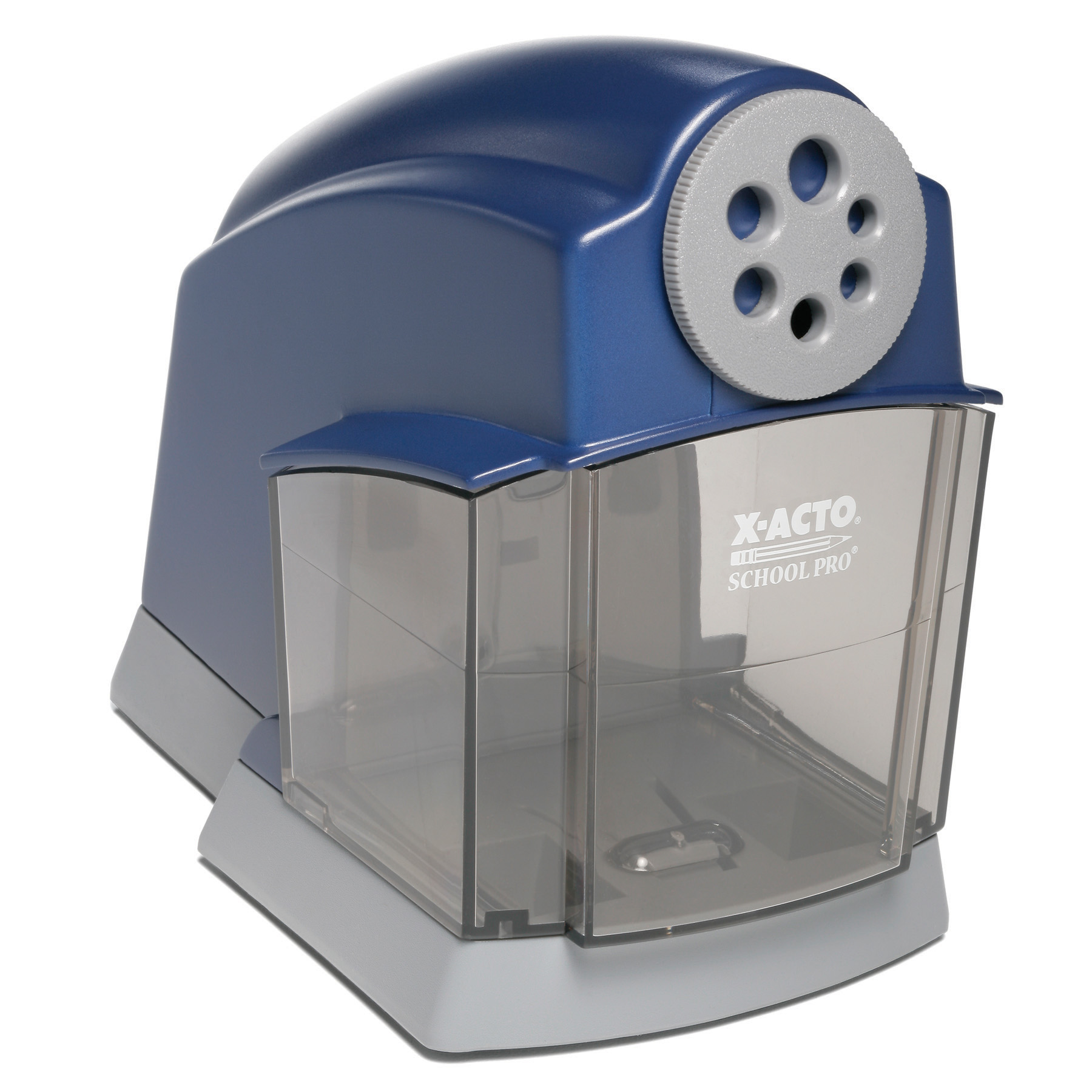
A six-size selection dial is the practical reason to choose the X-ACTO School Pro 1670. In a shared elementary classroom, standard writing pencils, larger triangular beginner pencils and other wooden pencil shapes often end up at the same station. Matching the dial to the pencil avoids the poor fit of a single-hole sharpener, although diameter and exact shape still need checking. X-ACTO describes a flyaway cutter intended to stop unnecessary sharpening after a usable point forms. The large bin is helpful when many students sharpen in quick succession, and SafeStart disables operation while the shavings receptacle is removed. This does not eliminate the need to supervise younger children or follow the instructions. Compared with a small personal sharpener, the School Pro occupies more desk space and requires users to choose the correct opening. For a mixed-size classroom, that is often a worthwhile tradeoff. For one standard pencil at a home desk, a simpler, smaller model may be sufficient.
Model detail: Six-size selector dial; Corded; Flyaway cutter.
3. Bostitch QuietSharp 6 EPS10HC
Best for: Classrooms prioritizing lower operational noise and six pencil openings
The QuietSharp 6 EPS10HC is designed around the repeated demands of a classroom but differentiates itself by emphasizing quieter operation. Its six openings are useful when pupils share the station with multiple pencil diameters; the dial is not an invitation to insert crayons, plastic-bodied writing tools or any object that happens to fit. Bostitch documents a hardened cutter, thermal overload protection and a MagnaSafe safety switch that disables the unit when the shavings bin comes off. Tip Saver is intended to reduce unnecessary consumption of the pencil after the point forms. Pay attention to material limitations before buying: some specialist retail listings caution against using colored pencils, so do not assume every soft core is compatible. As with all plug-in sharpeners, place it where the cord cannot be pulled across a walkway. It is a stronger fit for a classroom pencil station than for someone wanting a lightweight travel or battery-powered sharpener.
Model detail: Six-hole dial; check pencil type; Corded; hardened helical cutter.
4. Bostitch SuperPro 6 EPS12HC
Best for: High-use staff rooms, schools and commercial writing stations
The Bostitch SuperPro 6 EPS12HC is a substantial desktop sharpener intended for high-traffic environments. Its fan-cooled, thermally protected motor and six-size selector make the most sense where many people sharpen pencils throughout the day. A large base with suction feet helps the machine stay put when users insert or remove pencils, although the surface should still be level and clean. Bostitch also describes Tip Saver technology and a safety switch tied to the shavings receptacle. Those features address two common classroom frustrations: rapidly shortened pencils and a machine running while the bin is open. The compromise is footprint and cost: an office that sharpens a few pencils each week has little reason to devote this much permanent desk space to a sharpener. The SuperPro is also not a license to grind delicate art media without checking compatibility. It rewards the buyer who genuinely needs commercial-use capacity rather than the largest motor for its own sake.
Model detail: Six selectable sizes; Corded; fan-cooled motor.
5. Westcott iPoint Evolution Axis 15509
Best for: Shared creative desks requiring adjustable pencil diameters
The Westcott iPoint Evolution Axis 15509 is worth examining when a school or creative space uses more than one diameter of traditional wood-cased pencil. Manufacturer instructions describe an adjustable guide for six sizes, with a stated upper range of about 11 mm, plus motor stopping when the pencil reaches the intended point. That gives users more flexibility than a single-size desk sharpener without requiring a separate manual tool for every pencil diameter. The main buyer question is whether the pencils themselves are suitable: a wide opening does not establish compatibility with brittle pastel cores, unusually soft colored materials or nonwood casings. A school that uses the same standard pencil all day may not take full advantage of the selector. Before purchasing, allow room beside the desk for opening and emptying the shavings compartment. The iPoint Evolution Axis is a thoughtful middle ground for users who value a multi-size guide and automatic stop more than an ultra-compact footprint.
Model detail: Adjustable dial; up to 11 mm stated; Corded; auto-stop.
6. X-ACTO TeacherPro Classroom, Blue
Best for: Teachers wanting a dedicated classroom sharpening station
The blue X-ACTO TeacherPro Classroom sharpener is an alternative to general-purpose desk units when the sharpener serves an entire room rather than one student. Its appeal is workflow: a stable corded station, a removable receptacle for shavings and a design intended to produce serviceable points without consuming pencils unnecessarily. TeacherPro listings describe point-control or completion indicators, but buyers should confirm the exact revision and color offered before relying on a specific light or dial feature; similarly named TeacherPro products are not necessarily identical. That distinction matters when replacing an older classroom unit or ordering multiple matching sharpeners. Check the opening and expected pencil mix rather than assuming it accepts every jumbo or triangular pencil. Position the unit somewhere children can reach safely under supervision, with space for the bin to be withdrawn. The TeacherPro suits teachers who prioritize a permanent room fixture over portability or battery operation.
Model detail: Classroom wood pencils; verify dial setting; Corded; classroom design.
7. X-ACTO Powerhouse 1799
Best for: Workrooms using standard pencils in frequent batches
The X-ACTO Powerhouse 1799 emphasizes sturdy, frequent sharpening rather than a large array of pencil openings. Its upright body and hardened cutter make sense in a workroom where users repeatedly sharpen standard pencils for marking, notes or routine drawing. The flyaway mechanism is intended to stop excess cutting after a point is formed, and SafeStart prevents normal operation while the shavings bin is removed. Retail listings also reference colored-pencil compatibility, but that should not be read as a promise for every waxy or soft-core artist pencil: consult the exact manufacturer’s restrictions and test material only as directed. Because the main opening is a single size, a preschool room with thick first-writing pencils would be better served by a verified multi-size unit. This model is especially logical for a stationary home-office or shared workbench where the pencil type is predictable and a robust shavings bin is appreciated. It is less versatile than the School Pro for mixed pencil diameters.
Model detail: Single main pencil opening; Corded; hardened helical cutter.
8. Bostitch Vertical EPS5V-BLK
Best for: Small home desks and study corners with standard pencils
If the sharpener will sit next to a laptop, monitor or homework notebook, the Bostitch Vertical EPS5V-BLK makes a different compromise from classroom machines. Its upright orientation minimizes the horizontal desk area taken by the body, while the translucent shavings tray makes it easier to notice when cleaning is due. Bostitch documents a bin safety switch and thermal protection, both useful even for occasional home use. There is one main pencil opening, so verify that the family uses compatible standard wood pencils before choosing it over a six-size model. The absence of a selector keeps daily use simple for an older student but does not make the machine suitable for oversized beginner pencils. Keep the power cord neatly routed behind the desk and empty the tray before it fills. A quiet electric pencil sharpener for an office is not necessarily the most powerful one; for a small desk, convenient size and predictable operation may matter more.
Model detail: Single standard-pencil opening; Corded; vertical compact design.
9. X-ACTO Mighty Mite Electric
Best for: Occasional homework and compact family workspaces
The X-ACTO Mighty Mite is a practical small electric pencil sharpener for a home desk where only a few pencils need attention at a time. Its main advantage is the absence of classroom-scale bulk. Pencil Saver is intended to reduce excess sharpening, and SafeStart helps prevent the motor running with the shavings bin removed. The straightforward single-opening design means users do not have to choose a setting every time, provided their pencils are the supported standard type. For a teacher expecting a long queue after every art class, this is not the same proposition as the SuperPro or School Pro; smaller mechanisms and bins naturally require more frequent attention. Households with jumbo beginner pencils should check actual diameter compatibility first. Although some product descriptions mention colored pencils, verify suitability for the specific material rather than risking soft-core jams. Choose it for convenience and easy desk placement, not for the highest possible duty cycle.
Model detail: Standard wood pencils; Corded; compact motor.
10. AFMAT PSX2 Six-Hole, Black
Best for: Classrooms sharing regular and jumbo wooden pencils
The black AFMAT PSX2 offers six separate openings instead of expecting every student to use one standard pencil size. AFMAT states that the design fits a broad mix of ordinary and jumbo wooden pencils, including round, triangular and hexagonal shapes within its specified diameter range. That can simplify a shared elementary-school supply station where thicker beginner pencils would not fit a compact single-opening machine. The manufacturer also describes automatic stopping to reduce unnecessary pencil consumption. Because the six openings are physical sizes, teach users to select the closest appropriate fit instead of pressing a pencil into a smaller hole. The model is corded, so it belongs on a stable desk with safe cable routing rather than being passed around a room. If your art program frequently uses soft wax-core or specialty pencils, confirm that material compatibility separately. It is a strong electric pencil sharpener for jumbo pencils when adjustable fit is the actual purchasing priority.
Model detail: Six holes; approx. 6–11 mm range; Corded; automatic stop.
How to Choose an Electric Pencil Sharpener
1. Start with the pencil you actually use
Standard wood-cased graphite pencils are generally the easiest fit; oversize triangular beginner pencils need a compatible opening. An electric pencil sharpener for jumbo pencils should specifically list its supported diameter range and should hold the pencil firmly without forcing it. The School Pro, iPoint Axis and PSX2 offer multi-size approaches, while the Mighty Mite and Bostitch Vertical are simpler for routine standard pencils.
2. Match workload to motor protection
One desk may sharpen only a few pencils a day. A classroom sharpener can be used in several bursts with little rest. Thermal overload protection is valuable for repeated use, but it is a protection mechanism, not permission to ignore a motor that has become hot. The SuperPro emphasizes a fan-cooled motor; the PS13 and QuietSharp 6 also publish motor-protection guidance. A quiet electric pencil sharpener for office use is helpful during calls or focused work, but documented cutter noise, motor capacity and size matter more than unmeasured quietness claims.
3. Understand auto-stop and safety interlocks
An electric pencil sharpener with auto stop is intended to reduce wasted pencil length, which is useful for frequent school or art use. This point-control feature is separate from a shavings-bin interlock: the latter prevents motor operation while the bin is removed. Look for both if young students will use a shared station, and supervise them according to the manufacturer’s age guidance. Never bypass a safety switch.
4. Verify art-pencil compatibility instead of guessing
An electric pencil sharpener for colored pencils may work with ordinary colored pencils but still reject very soft, wax-rich or pastel cores. Those cores can break inside a cutter, leaving fragments that cause jams. AFMAT specifically warns against soft-core pencils in its PS13 guidance. Artists should preserve an alternative manual sharpener for delicate media whenever the electric model’s support is unclear.
5. Choose for available desk space and value
A small electric pencil sharpener for home desk use should be easy to position beside books and comfortable to empty without knocking over other supplies. A six-hole commercial model is usually overkill if only one person sharpens two standard pencils a day. Conversely, a tiny bin can become inconvenient for a busy classroom. Compare purchase cost with replacement-cutter availability, bin size, power requirements and likely upkeep rather than relying only on promotional speed claims.
Setup, Everyday Use and Maintenance
Place the sharpener on a stable, dry surface near an accessible power outlet. Keep the cord away from walkways, water and places where a child could snag it. Set a multi-hole dial to the correct pencil size first; insert the wood pencil straight and with gentle pressure. Stop when the model signals completion or according to its instructions, rather than pushing longer to create an excessively short point. Empty shavings before the bin reaches the cutter area. Disconnect power before cleaning or removing a stuck fragment; always follow the exact manual’s safe clearing procedure.
Problem: The motor suddenly stops
Check whether the plug is secure and the shavings bin is fully seated. Some models disable operation while the bin is removed; others stop to protect an overheated motor. Allow the machine to cool as directed before retrying. If it repeatedly stops during short, normal use, consult the manufacturer rather than forcing the cutter to turn.
Problem: Pencil tips repeatedly snap
Look for a pencil with an already fractured core, an unsuitable diameter or too much downward pressure. Try a sound, compatible pencil with a straight insertion angle. If the sharpener has a point-control feature, let it end the cycle instead of repeatedly reinserting the same pencil. Do not insert a different object to ‘clean’ a moving cutter.
Problem: Soft colored-pencil lead jams the cutter
Stop using the incompatible pencil, unplug the sharpener and follow the model-specific instructions for clearing fragments. Do not pour water into the motor housing or probe powered blades. For very soft art materials, a suitable manual sharpener may be less destructive than an electric mechanism.
Problem: Shavings spill or the sharpener vibrates
An overfull or incorrectly seated bin can cause mess and may interfere with safety interlocks. Empty and reseat it firmly. Clean a suction-foot base and the desktop so the unit cannot walk across the surface. Always keep vents unobstructed and place the unit away from a table edge.
Frequently Asked Questions
QDo I need a six-size sharpener for ordinary No. 2 pencils?
No. If all users have standard wood-cased graphite pencils, a single-opening model is often simpler. Multi-size models earn their space when pupils use thicker or varied pencils.
QWill an electric sharpener damage colored pencils?
Some support colored pencils, but soft, waxy and pastel cores can jam certain cutters. Check the exact material guidance, not only a retailer’s category label. A dedicated art-pencil sharpener may be wiser for costly soft cores.
QWhat is the best electric pencil sharpener for a classroom?
Choose by pencil mix and session volume. School Pro is attractive for mixed sizes, SuperPro for heavy traffic, and PSX2 for wide beginner pencils. No single model fits every class, and safety supervision remains essential.
QIs an electric sharpener with auto stop the same as a safety switch?
No. Point auto-stop helps protect pencil length. A removable-bin interlock prevents operation while the receptacle is absent. Look up each feature independently on the exact model page.
QHow often should I empty and clean it?
Empty the bin before shavings reach the cutter or motor ventilation. Frequency depends on usage; a busy classroom can fill a bin much faster than a home desk. Disconnect power first and follow the manual.
QWhich is better for a small home office?
For standard pencils, the Bostitch Vertical or X-ACTO Mighty Mite uses less desk area than commercial classroom units. If you routinely sharpen oversized pencils, choose a model whose openings list your diameter.
Related Desk and Learning Guides
Building a comfortable study space? Our home photo and scanning printer guide explains printing and scan tradeoffs; our college algebra calculator guide compares classroom tool requirements. For detailed collecting and art-adjacent visual work, see our digital coin microscope comparison.
Final Verdict
For a mixed-size elementary classroom, start with the X-ACTO School Pro 1670 because its size dial, roomy receptacle and bin interlock address daily practical needs. If a shared facility truly sharpens pencils continuously, the Bostitch SuperPro 6 is the more specialized heavy-use option. Home desks where pencils are all a standard diameter can save space with the Bostitch Vertical or X-ACTO Mighty Mite. For classrooms using thick beginner pencils, the AFMAT PSX2 is worth comparing against your actual pencil diameters. Whichever model you choose, material compatibility and safe, convenient maintenance matter more than a flashy speed claim.
Manufacturer and Safety Resources
For model-specific instructions, see the X-ACTO electric-sharpener guide, Bostitch product manuals, Westcott support, and AFMAT model information. Product features can vary by revision and regional packaging; consult the exact purchased model’s instructions.
Disclosure: As an Amazon Associate, Size Them Up earns from qualifying purchases.
Featured photograph: Qxtn1423 / Wikimedia Commons, CC BY-SA 3.0, unmodified. It shows an earlier School Pro version for illustration; the ten reviews describe the exact models named above.