Torque Wrenches for Car Maintenance: Drive Sizes, Ranges and Calibration

When comparing torque wrenches for car maintenance, start with the fastener rather than the tool’s marketing claims. A wheel lug nut, a small engine-cover bolt and a suspension fastener can require dramatically different torque values. A large wrench may have plenty of leverage but be unsuitable at the low end of its scale; a compact inch-pound wrench can protect delicate threads yet cannot tighten wheels. Click, split-beam and electronic models also demand different habits for setting, reading, storage and calibration. This guide explains how to match drive size and working range to real automotive tasks, why measurement direction matters, and what a calibration certificate actually tells you. It compares researched models by the jobs they suit and identifies common mistakes that can damage components. All vehicle-specific torque values must come from the vehicle or component manufacturer’s current service instructions, not a generic chart.
Featured photograph: Fatih Erden / Pexels (Pexels License).
Quick Picks by Application
- CDI 2503MFRPH — higher-torque mechanical work
- GEARWRENCH 85077 — electronic alerts
- TEKTON TRQ51402 — engine work
- LEXIVON LX-181 — inch-pound fasteners
Torque Wrench Comparison
A torque wrench for lug nuts must cover the exact vehicle-specified torque, but the same tool may be unsuitable for small engine hardware. Compare working ranges and mechanisms before selecting a wrench for a particular fastener. A half-inch drive alone does not establish whether a tool can safely measure low torque. Product photographs and the orange buttons link to the corresponding Amazon detail pages.
| Model | Drive & torque range | Mechanism | Amazon |
|---|---|---|---|
| 1/2 in / 30–250 ft-lb | Micrometer click | Check the latest price on Amazon | |
| 1/2 in / 25–250 ft-lb | Electronic | Check the latest price on Amazon | |
| 1/2 in / 40–250 ft-lb | Split beam, flex head | Check the latest price on Amazon | |
| 1/2 in / 40–200 ft-lb | Dual-direction micrometer click | Check the latest price on Amazon | |
| 1/2 in / 14.8–147.5 ft-lb | Electronic | Check the latest price on Amazon | |
| 3/8 in / 10–100 ft-lb | Dual-direction micrometer click | Check the latest price on Amazon | |
| 1/2 in / 10–150 ft-lb | Micrometer click | Check the latest price on Amazon | |
| 1/4 in / 20–200 in-lb | Inch-pound micrometer click | Check the latest price on Amazon | |
| 1/2 in / 50–250 ft-lb | Micrometer click | Check the latest price on Amazon | |
| 1/2 in / 40–300 ft-lb | Dual-direction micrometer click | Check the latest price on Amazon |




How to Choose a Torque Wrench for Car Maintenance
Match the torque range before the drive size
First write down the specified tightening value for each task. Select a wrench that is rated for that number; do not assume the lowest number on the scale is covered by the same accuracy claim as the middle of the range. A half-inch torque wrench for wheel lug nuts is convenient when its calibrated range covers the vehicle’s specified value. A three-eighths-inch torque wrench for engine bolts can provide a smaller head and more useful lower-range settings; a quarter-inch inch-pound wrench handles delicate work. These are categories of application, not proof that a particular size fits every fastener. These are practical patterns, not substitutes for checking the specific tool and fastener.
Understand click, split-beam and electronic designs
A micrometer click wrench uses a settable handle and a tactile signal. A split-beam wrench uses a different measuring mechanism and may not need its setting backed down after use, but the manufacturer’s instructions control. A digital torque wrench for automotive repairs can show live readings and provide sound, vibration or light alerts, at the cost of batteries and additional controls. For an occasional wheel change, weigh that convenience against the upkeep and price. None of these systems compensates for an incorrect torque target.
What calibration paperwork can and cannot prove
A serialized certificate documents testing of a specific wrench under stated conditions. Look for the test standard, measurement direction and portion of the range covered. It does not prove the tool will remain accurate indefinitely, particularly after drops, overloads or hard use. Good torque wrench calibration and storage habits include following the maker’s test interval, keeping the tool protected from impact, and seeking professional inspection if damage is suspected.
Decision aid by job
- Passenger-car lug nuts: A torque wrench for lug nuts must cover the actual wheel specification. Consider a half-inch wrench whose range comfortably includes that value.
- Engine and brake components: A three-eighths-inch torque wrench for engine bolts can make access easier, but compare its rated range with the actual fastener value.
- Small threaded components: An inch-pound torque wrench for small fasteners is appropriate only if its range, units and drive size match the manufacturer’s specification.
- Frequent setting changes: Consider a split-beam mechanism.
- Hard-to-read scales: Consider an electronic model with clear target feedback.
Buying Tip: Make a short list of your vehicle’s five most common torque specifications and their units before choosing a wrench. Buy for the actual working range rather than the largest advertised maximum.
Research-Based Torque Wrench Reviews
1. CDI 2503MFRPH
Best for: experienced DIY owners tightening wheels and higher-torque chassis fasteners
The CDI 2503MFRPH uses a conventional click mechanism and a long handle suited to substantial torque settings. Its published range begins at 30 ft-lb, so it is not a sensible choice for small valve-cover fasteners or delicate threaded aluminum components. A serialized calibration certificate can help a careful owner track the tool and plan future checks. Before purchase, confirm that the exact model and the current calibration paperwork are included in the offer. The long handle gives useful leverage on wheel and suspension work but is awkward in a crowded engine bay. The user still needs to follow the vehicle’s specified torque and tightening sequence, and a click is a signal to stop pulling rather than permission to add extra force. This is a specialist high-range tool, not a replacement for a low-range wrench.
Drive and mechanism: 1/2 in click. Rated range: 30–250 ft-lb.
Advantages: Long handle provides leverage; Documented calibration; Suitable for higher torque specifications. Limitations: Low end too high for small bolts; Long body limits tight access.
2. GEARWRENCH 85077
Best for: users who prefer visible readings and audible or tactile target alerts
If you want a digital torque wrench for automotive repairs, the GEARWRENCH 85077 replaces the mechanical click-only experience with an electronic torque readout and multiple target alerts. Vibration, sound and light can be valuable in a busy garage when the operator might miss a quiet mechanical click. Its stated accuracy varies by direction and by the portion of the scale being used; do not interpret the headline figure as guaranteed at every possible setting. Battery condition and electronics add upkeep compared with a conventional click wrench. The half-inch drive is most relevant to wheel and chassis fasteners, although the full stated range should always be compared with the vehicle service specification. Users who need torque-plus-angle work should verify that the exact wrench supports the required function rather than assume all electronic models do. A digital display improves readability, but it does not excuse an incorrect socket, sequence or torque target.
Drive and mechanism: 1/2 in electronic. Rated range: 25–250 ft-lb.
Advantages: Electronic target alerts; Multiple display units; Useful higher torque range. Limitations: Requires batteries; Do not assume angle mode.
3. Precision Instruments PREC3FR250F
Best for: frequent wheel work where quick setting changes are useful
The Precision Instruments PREC3FR250F is a split-beam wrench with a flex head, designed for operators who repeatedly change torque settings. Unlike a micrometer click wrench with a loaded spring, a split-beam mechanism can generally be stored at its selected setting according to its maker’s directions. The flex head can help with access around wheel wells or other obstructions, but its position and effective lever length deserve attention when precision matters. Because published retailer specifications for this exact variant can be sparse, check the working range, included case and calibration documentation against the model number before buying. It is less appropriate for tiny fasteners, and the long half-inch-drive format will not substitute for a quarter-inch low-torque wrench. A serious home mechanic may appreciate the workflow; an occasional tire rotation may not justify the expense.
Drive and mechanism: 1/2 in split beam. Rated range: 250 ft-lb class.
Advantages: Split-beam setting convenience; Flex head for access; Long handle leverage. Limitations: Large for engine-bay work; Confirm exact calibration paperwork.
4. TEKTON TRQ52402
Best for: buyers prioritizing readable mechanical adjustment and calibration records
The TEKTON TRQ52402 is a micrometer-style torque wrench with a fine-tooth ratchet and a documented calibration approach. Its attraction is mechanical simplicity: set the target, lock the handle as instructed and apply steady pressure until the click. TEKTON emphasizes bidirectional calibration for this family, which matters when a vehicle specifies tightening in a nonstandard direction. Be especially careful with the product number and drive size, since similar-looking TEKTON wrenches cover very different ranges. The correct choice depends on whether the vehicle’s common torque settings fall comfortably inside the wrench’s published operating limits. After use, follow the manual’s storage instructions rather than leaving the handle at an arbitrary high setting. Owners should not use the wrench to break seized bolts loose, and should have it inspected if dropped or subjected to unusual force.
Drive and mechanism: 1/2 in micrometer click. Rated range: Manufacturer-published range varies by listing; confirm variant.
Advantages: Mechanical operation without batteries; Fine-tooth ratchet; Manufacturer calibration support. Limitations: Requires correct storage setting; Check exact model range.
5. ACDelco ARM601-4
Best for: drivers seeking digital torque feedback on typical passenger-car jobs
The ACDelco ARM601-4 provides an electronic readout and target feedback for people who find a traditional etched micrometer scale difficult to read. Its range reaches into many passenger-car wheel specifications, but the upper limit is lower than several larger half-inch torque wrenches. That makes it a questionable all-purpose choice for large-truck or high-torque chassis work. The peak and trace modes can help the user understand how torque changes during a pull, provided the correct units are selected. Digital accuracy claims need to be read alongside the portion of the scale for which they apply. Batteries are another ownership consideration, especially when the wrench spends months in a toolbox. Match the exact product number to the retail offer, confirm included calibration documentation and use the vehicle service manual for the actual setting rather than relying on generic lug-nut charts.
Drive and mechanism: 1/2 in electronic. Rated range: 14.8–147.5 ft-lb.
Advantages: Electronic peak/trace feedback; Useful midrange torque settings; Readable digital display. Limitations: Upper range below larger tools; Battery maintenance.
6. TEKTON TRQ51402
Best for: engine and brake fasteners needing a smaller drive and head
The TEKTON TRQ51402 is a more natural companion to a half-inch wheel wrench than a replacement for it. Its three-eighths-inch drive and smaller form factor suit many engine-bay jobs where clearance is limited and torque values are below those of wheel lug nuts. A micrometer handle provides a visible setting, and the manufacturer’s calibration information helps buyers distinguish it from generic uncalibrated ratchets. A three-eighths-inch drive does not automatically mean the wrench is appropriate for every brake or engine bolt; the exact torque value must fall within its certified range. It is important to use the correct socket and tighten in the prescribed sequence, particularly around gaskets or aluminum housings. Keep the tool clean, avoid impacts and return it to the manual’s specified storage setting after use. For someone primarily servicing smaller components, this may be more useful than buying the largest wrench first.
Drive and mechanism: 3/8 in micrometer click. Rated range: Check manufacturer range for exact revision.
Advantages: Compact drive for engine work; Mechanical adjustment; Calibration documentation. Limitations: Not a wheel-lug substitute; Exact range must match the job.
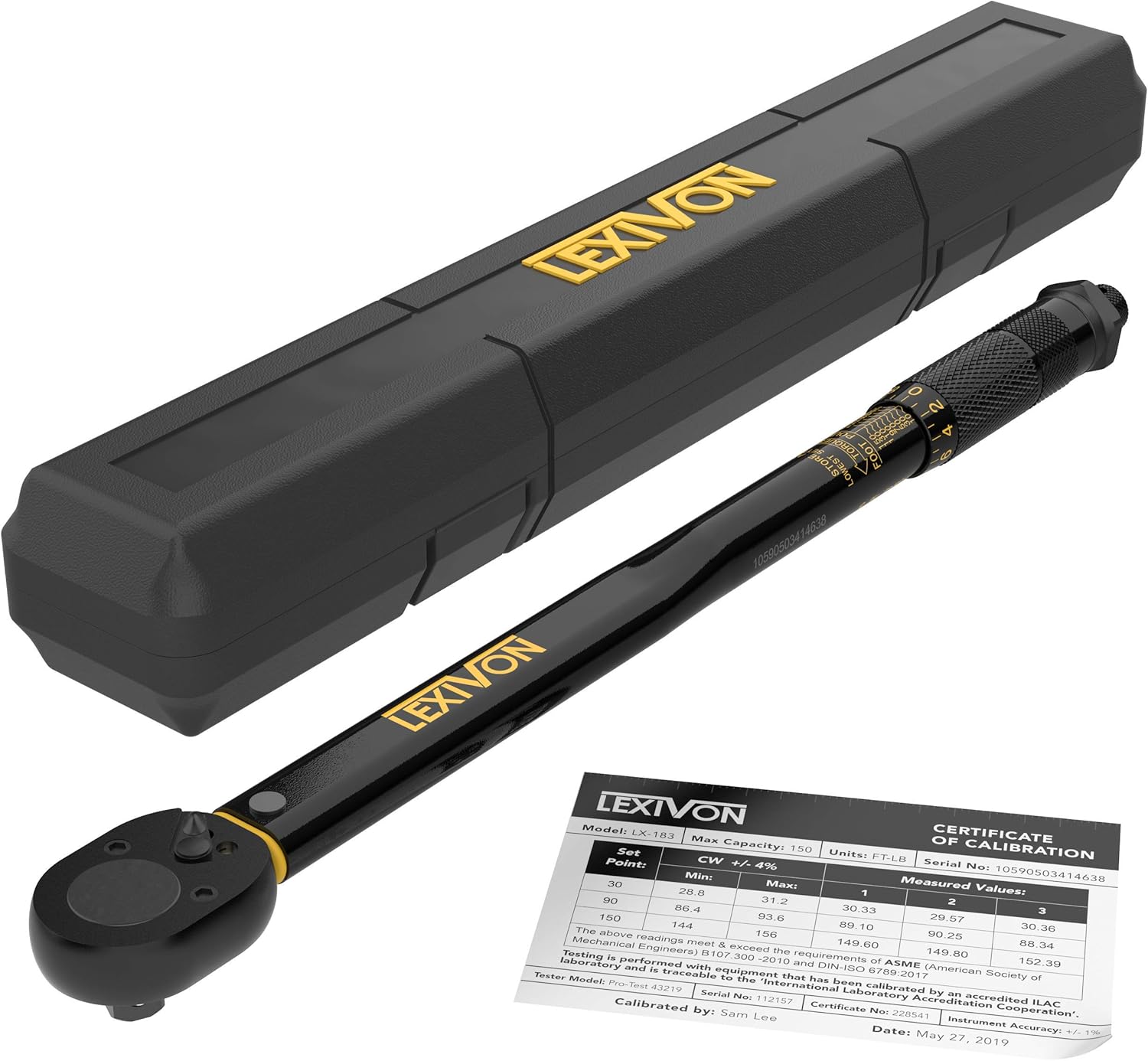
7. LEXIVON LX-183
Best for: occasional passenger-car wheel service on a budget
The LEXIVON LX-183 is a half-inch click torque wrench aimed at straightforward home maintenance. A stated range from 10 to 150 ft-lb covers many ordinary passenger-car tasks, but it does not provide the higher headroom of a 250 ft-lb model. The handle’s high-contrast markings may help users read the setting in a garage, and the carrying case is useful for protecting a calibrated instrument from impacts. Check the manual for which tightening direction is actually measured: a ratchet reversing does not necessarily mean the wrench measures torque accurately in both directions. This model is an occasional-use choice rather than a guarantee of professional calibration longevity. If you are servicing a heavy truck, high-torque suspension fasteners or small inch-pound components, compare the required values before buying. As with any click wrench, stop when the signal is reached and store it as instructed.
Drive and mechanism: 1/2 in click. Rated range: 10–150 ft-lb.
Advantages: Readable scale; Broad passenger-car range; Protective storage case. Limitations: 150 ft-lb upper limit; Clockwise measurement limitation.
8. LEXIVON LX-181
Best for: small bolts and inch-pound service specifications
The LEXIVON LX-181 is an inch-pound torque wrench for small fasteners, with a quarter-inch drive that makes it fundamentally different from a wheel-lug wrench. Small engine covers, some accessories and other delicate fasteners may call for values expressed in inch-pounds rather than foot-pounds. A user who misreads those units can overtighten a component by a large factor, so the scale and the service manual should be checked before every unfamiliar task. The compact drive helps in tight spaces and the stated range is useful for low-torque work, but it is not suitable for wheel lug nuts or high-torque suspension hardware. Pay attention to the direction in which the wrench is rated to measure, even if the ratchet head can reverse. Follow the maker’s instructions for calibration and storage. Its value is precision at the low end, not the ability to cover every job in the garage.
Drive and mechanism: 1/4 in click. Rated range: 20–200 in-lb.
Advantages: Low inch-pound range; Compact quarter-inch drive; Useful for delicate fasteners. Limitations: Not suitable for lug nuts; Unit conversion mistakes are consequential.
9. CRAFTSMAN CMMT99434
Best for: Routine wheel and suspension work needing a readily available half-inch wrench
The CRAFTSMAN CMMT99434 fills a useful middle ground for someone who routinely rotates wheels, changes tires, or performs other vehicle work with substantial torque requirements. It is a half-inch-drive micrometer click wrench with a published 50–250 ft-lb range. That high starting point is both a strength and a limitation: it provides room for many wheel and chassis specifications but is not meant for small engine bolts. Unlike a display-equipped electronic model, it relies on a mechanical setting and a tactile click as the desired torque is reached. That avoids battery maintenance, but it places more responsibility on reading and locking the scale correctly. Before ordering, compare the vehicle’s precise torque requirement with the calibrated range, confirm the exact CMMT99434 package, and consider whether its long handle will fit your working space. If most jobs fall below 50 ft-lb, pair it with a suitable lower-range wrench rather than trying to use this instrument below its scale.
10. TEKTON TRQ52403
Best for: Higher-torque truck and chassis work when a 200-ft-lb wrench lacks range
The TEKTON TRQ52403 is the high-range companion to smaller micrometer-style wrenches. TEKTON lists a 40–300 ft-lb operating range, a half-inch drive, a 90-tooth ratchet, and calibration for both tightening directions. That range can be valuable when a larger vehicle or specific chassis procedure exceeds a typical 150- or 200-ft-lb wrench. It does not mean the tool should be selected for every bolt under the hood: the minimum setting is still far above many small engine and interior fastener requirements. Its long handle provides leverage but needs clear access around the work. A buyer should confirm the exact model number because the similarly named TRQ52402 tops out at 200 ft-lb. Use manufacturer vehicle specifications for every application, stop at the click, and follow TEKTON’s storage and recalibration guidance after heavy use or a suspected overload. For owners who never need values over 200 ft-lb, the extra capacity may add bulk without a practical benefit.
Setup, Mistakes and Maintenance
Do not confuse inch-pounds and foot-pounds
One foot-pound equals twelve inch-pounds. A small fastener specified in inch-pounds can be badly overtightened if the number is applied as foot-pounds. Verify the units printed in the service instructions and on the tool before setting it.
Stop when the click or alert occurs
Repeatedly clicking the wrench on an already tightened fastener is not a sound method of improving accuracy. Use a smooth pull at the prescribed grip location and stop at the first proper indication. Never use the torque wrench as a breaker bar to free a seized fastener.
Use the prescribed sequence and thread condition
Some fasteners require a staged tightening sequence, specific thread preparation or new hardware. Applying lubricant when the maker calls for dry threads can change clamping force. Follow the exact vehicle or component service procedure, including any torque-plus-angle step.
Recheck after impacts or questionable readings
Torque wrench calibration and storage are practical ownership concerns: a wrench that has been dropped, overloaded or damaged should be checked against the manufacturer’s instructions and professionally recalibrated when appropriate. Keep the tool in its case and store a spring-loaded click wrench at the recommended minimum setting, not below the calibrated scale.
Adapters and crowfoot attachments can change the result
Attachments that alter the effective lever length can require a torque correction. Follow the wrench manufacturer’s documented method for your attachment geometry rather than using a guessed percentage. TEKTON’s split-beam manual illustrates why crowfoot alignment matters.
Frequently Asked Questions
Is a half-inch torque wrench enough for all car maintenance?
A half-inch torque wrench for wheel lug nuts can cover many vehicle requirements when its working range matches the specified value. It does not cover all car maintenance: small engine fasteners may need a lower-range three-eighths-inch or quarter-inch tool. Never assume a socket fitting onto the drive means the tool can accurately measure the required torque.
Can I use a torque wrench to loosen lug nuts?
Use an appropriate breaker bar or another manufacturer-approved loosening tool instead. A torque wrench is primarily a measuring instrument, not a replacement for a breaker bar; excessive force can damage or alter it. If an impact wrench was used for removal, use the correct torque wrench to complete final tightening according to the vehicle’s service procedure.
Does a reversible ratchet measure torque in both directions?
Not necessarily. A ratchet head may reverse for convenient repositioning even when the measuring mechanism is calibrated only for clockwise tightening. Check the exact model’s direction-specific calibration documentation and use the specified tightening direction. This matters especially for left-hand-threaded components, where choosing a tool by ratchet direction alone can be misleading.
How often should I recalibrate a torque wrench?
Follow the manufacturer’s stated inspection and recalibration requirements, with earlier checks after drops, overloads, abnormal behavior or suspect readings. Usage intensity and the criticality of the work matter. A certificate shows results at a point in time; it is not a permanent promise of accuracy. Store the tool according to the manual between uses.
Can I use the same setting for dry and lubricated threads?
No such assumption is safe. Lubricant, anti-seize, dirt or damaged threads can alter friction and the resulting clamping force at a given indicated torque. Follow the vehicle or component manufacturer’s thread-preparation instructions; do not add lubricant merely because a torque value seems high. Some jobs also specify new bolts or a sequence of tightening stages.
What if my vehicle specifies torque plus angle?
Follow the complete vehicle or component service procedure rather than stopping after the preliminary torque step. A conventional click wrench measures torque but not a separate angular rotation. Use an approved angle gauge or torque-angle tool and replace any specified single-use fasteners. Skipping the angle stage can leave a joint improperly clamped.
Final Verdict
For frequent wheel service, first compare the CDI 2503MFRPH and TEKTON TRQ52402 against the torque values in your service manual. If a digital alert is useful, the GEARWRENCH 85077 is worth considering. For a traditional 50–250 ft-lb half-inch wrench, compare the CRAFTSMAN CMMT99434. For higher-torque tasks that genuinely require up to 300 ft-lb, the TEKTON TRQ52403 offers added capacity. For lower-torque engine tasks, consider the TEKTON TRQ51402; for inch-pound specifications, look at the LEXIVON LX-181. Check the full model description and the vehicle service instructions before ordering.
How We Selected These Torque Wrenches
This comparison is based on manufacturer specifications, model-number cross-checks and publicly available retail information; it is not a claim of hands-on laboratory testing. Torque ranges and calibration procedures are model specific, and changing retail stock is best checked on the linked retailer detail page. References include TEKTON’s 200 ft-lb model documentation, TEKTON’s 300 ft-lb model documentation, CRAFTSMAN’s CMMT99434 product information, ACDelco’s ARM601-4 specifications, LEXIVON’s LX-183 listing, and TEKTON’s calibration service guidance. Always use the vehicle or component manufacturer’s procedure for the actual tightening value, thread preparation and sequence.
Other automotive topics on Size Them Up include OBD2 diagnostic scanners, portable tire inflators and dash cameras.
As an Amazon Associate, Size Them Up earns from qualifying purchases.