Car Battery Chargers and Maintainers for Storage, AGM Batteries and Everyday Use
As an Amazon Associate, Size Them Up earns from qualifying purchases.
A car that sits through a long vacation, a motorcycle parked between rides, and a truck that makes only occasional short trips can all end up with the same problem: a weak starting battery. The answer is not always a more powerful jump starter. For a stored vehicle, a properly matched smart battery charger or maintainer can recharge a compatible battery and then keep it ready while the vehicle is parked. Choosing one is less about headline amperage and more about whether it supports your battery’s voltage, chemistry, and capacity. A small 12-volt powersports battery may need a very different charging routine than a large SUV battery, and an AGM label does not mean the same thing as lithium. This guide explains which charger features matter, how to avoid unsafe combinations, and which equipment configurations make practical sense for garages, driveways, and seasonal storage.
If you are comparing a car battery maintainer for winter storage with a faster charger for everyday garage use, you will find ten distinct models here, along with explanations of charging, common battery mistakes and the differences between trickle charging and automatic maintenance. If you need to start a disabled vehicle immediately rather than restore a battery over time, our portable jump starter guide covers that separate problem.
Quick Picks by Charging Need
NOCO GENIUS5 (5A) — an all-around charger for typical cars and occasional storage.
Battery Tender Junior 12V (750mA) — motorcycles, atvs and small lead-acid batteries in seasonal storage.
NOCO GENIUS10 (10A) — larger compatible batteries needing more charging headroom.
NOCO GENIUS2D Direct-Mount (2A) — a vehicle where permanent maintenance wiring is practical.
Schumacher SC1281 — garages needing routine charging, diagnostics and engine-start assistance.
How These Chargers Were Selected
We compared ten individually identifiable US-market charger models by charging current, documented battery modes, maintenance behavior, real-world storage scenarios, exact product-detail listings and model-specific photos. We used manufacturer documentation and retailer/product records rather than claiming hands-on laboratory tests. The list is organized by available Amazon customer-rating counts where credible figures could be checked; counts and listing details can change. We omit volatile price promises from the guide and recommend confirming the exact variant and current offer on Amazon before ordering. Product differences matter more than chasing a headline output figure.
Car Battery Chargers and Maintainers Compared
Each model name jumps to a detailed review. The photos and orange buttons open the corresponding product’s Amazon listing.
| Product | Charging | Best for | Amazon price |
|---|---|---|---|
|
1A · 6V/12VLead-acid, compatible lithium
|
Small batteries & storage | Check the latest price on Amazon | |
|
0.75A · 12VLead-acid only
|
Powersports maintenance | Check the latest price on Amazon | |
|
5A · 6V/12VLead-acid, compatible lithium
|
Everyday car batteries | Check the latest price on Amazon | |
|
6A charge · boost/start6V/12V lead-acid
|
Charging & diagnostics | Check the latest price on Amazon | |
|
15A charge · 3A maintain6V/12V lead-acid
|
Faster lead-acid charging | Check the latest price on Amazon | |
|
1.25A · 12VLead-acid only
|
Long-term vehicle storage | Check the latest price on Amazon | |
|
10A · 6V/12VLead-acid, compatible lithium
|
Larger vehicle batteries | Check the latest price on Amazon | |
|
2A · 12VLead-acid direct mount
|
Permanent installation | Check the latest price on Amazon | |
|
4.3A · 12VLead-acid only
|
AGM battery care | Check the latest price on Amazon | |
|
12A · 6V/12VLead-acid, LiFePO4 mode
|
Multiple battery types | Check the latest price on Amazon |
Detailed Charger Reviews
1. NOCO GENIUS1 (1A) — Small batteries and patient maintenance on lightly used vehicles

The GENIUS1 makes sense when the job is keeping a stored vehicle ready rather than rapidly restoring a deeply discharged full-size car battery. Its 1-amp output is deliberately modest. That can suit motorcycle, mower or other smaller batteries and can also maintain compatible vehicle batteries through long stretches of inactivity, but a drained SUV battery could take a long time to replenish. NOCO specifies support for 6- and 12-volt operation and multiple lead-acid types, plus a lithium mode for supported lithium batteries. Check the actual battery chemistry and its manufacturer’s instructions before selecting that mode. Thermal compensation is particularly useful when a garage experiences changing temperatures. The design is compact and relatively simple, although the different charging modes still require careful attention. Choose it for low-current convenience, not because a higher advertised battery capacity somehow turns it into a quick roadside rescue device. A jump starter performs a very different task.
Key specification: Compact 1-amp charging and automatic maintenance; 1A · 6V/12V. Battery support: Lead-acid, compatible lithium.
2. Battery Tender Junior 12V (750mA) — Motorcycles, ATVs and small lead-acid batteries in seasonal storage

The Battery Tender Junior is most compelling as a long-term companion to a small powersports battery. Its 750-milliamp charging current and four-stage operation emphasize steady maintenance rather than speed. If a motorcycle or lawn mower sits for weeks between outings, the charger can move from its charging stages into float maintenance when used with a compatible battery and according to the manual. That avoids the need to repeatedly guess whether a stored battery is ready, but it should not be confused with a high-output charger for a nearly flat truck battery. The manufacturer’s stated application is 12-volt flooded, AGM, gel and other supported lead-acid batteries; this particular Junior version is not a lithium charger. The model identifier matters because the company sells other Junior products with different outputs and chemistry choices. The included lead options are useful for a stored machine, provided connections are made as directed and the charging location meets safety guidance.
Key specification: Four-stage automatic charging and float maintenance; 0.75A · 12V. Battery support: Lead-acid only.
3. NOCO GENIUS5 (5A) — An all-around charger for typical cars and occasional storage

For someone choosing a 12V car battery charger with maintenance mode for an ordinary passenger car, the GENIUS5 strikes a useful balance. Five amps offers meaningfully more charging current than one-amp storage-focused devices while remaining manageable for many supported lead-acid battery sizes. The model supports both 6- and 12-volt operation, with dedicated options for AGM and compatible lithium chemistry according to NOCO. That range of modes is helpful only when selected correctly: check your battery’s exact type, allowable charging voltage and capacity instead of assuming every setting is universal. The GENIUS5 also includes temperature compensation and an automatic maintenance function, so it can address occasional recharging and planned storage with one unit. It is not an engine-starting booster, and no smart charger can promise to revive every damaged or sulfated battery. The practical appeal is one clearly differentiated midrange charger for owners who would otherwise buy a small maintainer and a separate more capable wall charger.
Key specification: Balanced 5-amp recharge rate with maintenance support; 5A · 6V/12V. Battery support: Lead-acid, compatible lithium.
4. Schumacher SC1281 — Garages needing routine charging, diagnostics and engine-start assistance

The SC1281 suits an owner who wants a full-size garage tool rather than a compact charger to hide near a stored motorcycle. Schumacher combines ordinary battery charging with a higher-current boost setting and an engine-start function, along with battery and alternator testing features. Those extra capabilities make it fundamentally different from the small maintainers in this comparison. A boost or engine-start rating must not be mistaken for the amperage used during ordinary maintenance, and the charger still needs access to a suitable AC outlet. Follow its manual carefully when choosing charging versus starting functions and when connecting to a vehicle. It is useful for investigating a recurring weak-battery problem, but its tester does not replace comprehensive electrical diagnosis when an alternator or parasitic draw is suspected. If the vehicle simply sits during winter, a smaller automatic maintainer may be tidier. For varied vehicles and occasional charging problems, this heavier tool brings several functions together.
Key specification: Charger with 30A boost and 100A engine-start function; 6A charge · boost/start. Battery support: 6V/12V lead-acid.
5. Schumacher SC1280 — Owners who want faster conventional charging plus float maintenance

The SC1280 fills the gap between a small smart maintainer and a large jump-assist garage machine. Its advertised 15-amp charging capability is intended for restoring charge more quickly on suitable lead-acid batteries, while its lower-rate maintenance behavior is aimed at keeping them ready once charged. The difference between those modes is important: a charging current is not a guarantee of a particular finish time, because battery size, remaining charge, condition and the device’s multistage algorithm all matter. Schumacher lists support for common 6- and 12-volt automotive lead-acid applications, including AGM and gel options, but this selection should not be treated as universally compatible with lithium batteries. The display and automatic controls can reduce guesswork once the correct battery type is identified. An owner who charges several parked cars over time may appreciate the extra capacity, while someone maintaining one small motorcycle battery could choose a simpler, lower-output unit.
Key specification: 15-amp automatic charger with lower-rate maintenance; 15A charge · 3A maintain. Battery support: 6V/12V lead-acid.
6. Battery Tender Plus 12V (1.25A) — Long-term storage of conventional 12V vehicle batteries

Battery Tender Plus is a classic choice for a garage where the biggest concern is a healthy 12-volt lead-acid battery losing charge over weeks of inactivity. At 1.25 amps it sits between the very small Junior and faster five- or ten-amp chargers. Its primary benefit is automatic charging followed by maintenance for compatible flooded, AGM, gel and similar lead-acid types. The supplied quick-disconnect arrangement can be convenient when a vehicle is parked repeatedly, but installation of any ring-terminal lead should follow the battery and vehicle instructions. The Plus name covers several variants; this linked model is the 12-volt 1.25-amp version, not the selectable 6V/12V model. That distinction is especially important around vintage equipment. For stored cars that do not need rapid recovery, a dedicated maintainer can be simpler than a multifunction charger with start-assist menus. It is a poor match for an unsupported lithium battery or for situations where fast charging is the main objective.
Key specification: Automatic charging and float maintenance with ring-terminal harness; 1.25A · 12V. Battery support: Lead-acid only.
7. NOCO GENIUS10 (10A) — Larger compatible batteries needing more charging headroom

The GENIUS10 is the higher-output counterpart to the GENIUS5, and that extra current makes sense when a compatible battery is larger or needs more substantial recharging. NOCO lists ten-amp output, 6- and 12-volt operation and charging profiles for multiple lead-acid types and supported lithium batteries. Those specifications are genuinely useful in a household with a truck, boat or other high-capacity battery, but the correct setting and allowable battery charge current still take precedence over raw charger power. A small battery does not benefit simply because a bigger charger advertises a larger number. The automatic maintenance function means this unit can also serve as a storage charger after recharging is complete, though that alone may not justify the additional cost for an infrequently used small battery. The housing, cables and attachment hardware require more room than a one-amp unit. Choose it when the higher charging rate is relevant, not as a replacement for a portable emergency jump starter.
Key specification: Ten-amp smart charging with automatic maintenance; 10A · 6V/12V. Battery support: Lead-acid, compatible lithium.
8. NOCO GENIUS2D Direct-Mount (2A) — A vehicle where permanent maintenance wiring is practical

The GENIUS2D is a distinctive choice because its form factor is meant for installation near a compatible vehicle battery instead of regular movement between different cars. It is a two-amp, 12-volt direct-mount charger and maintainer with ring-terminal connections and mounting hardware. That can be useful on equipment that repeatedly returns to the same storage space, especially when you prefer not to clip and unclip leads for each maintenance period. The tradeoff is flexibility. A permanently attached charger is less convenient if several vehicles share one maintenance device, and routing the power connection needs proper planning. NOCO lists lead-acid battery compatibility for this model, which differs from some of its portable GENIUS products that offer lithium modes. Follow the model’s vehicle-installation instructions and do not improvise battery wiring or position the device near heat or moving engine components. Its two-amp output is for steady charging and maintenance, not rapid recovery or engine cranking.
Key specification: Fixed-install 12-volt maintainer with ring-terminal leads; 2A · 12V. Battery support: Lead-acid direct mount.
9. CTEK MXS 5.0 NA (4.3A) — Owners seeking dedicated 12V AGM and lead-acid battery care

The MXS 5.0 NA is a focused option for drivers who prefer a 12-volt lead-acid specialist over a charger with many battery chemistries in its menu. CTEK describes a 4.3-amp output with an eight-step program and temperature compensation, plus modes for common flooded, AGM, EFB and gel batteries. Those details can matter to owners of vehicles with AGM batteries, where using a supported charging profile is more important than buying the highest-output tool. The North American model designation also matters: its input requirements and product documentation should match the market in which you plan to use it. Unlike several NOCO models in this guide, the MXS 5.0 NA is not sold as a lithium charger. Its current is adequate for many routine charging jobs, but a highly depleted large battery will take time, and a damaged battery may not be recoverable. Eyelet and clamp accessories support different use patterns provided you follow the instructions for your vehicle.
Key specification: Automatic multistep charging with temperature compensation; 4.3A · 12V. Battery support: Lead-acid only.
10. CRAFTSMAN CMXCESM258 (12A) — Drivers wanting a digital charger for several battery types

The CMXCESM258 brings a different balance of features to the same garage problem: a conventional charger body with a digital readout, automatic controls and several supported battery types. CRAFTSMAN specifies 12-amp charging for 12-volt batteries, alongside lower-output maintenance options and a 6-volt mode. The manufacturer also lists standard lead-acid, AGM and compatible LiFePO4 operation, making this worth comparing for households with more than one chemistry. That versatility comes with responsibility: a charging mode must be appropriate for the precise battery and vehicle, and lithium support should not be generalized to every lithium chemistry or battery-management system. The display can make charge progress easier to understand, although voltage or percentage indicators are not a substitute for a proper load test of an aging battery. The package is more substantial than a simple storage tender. It suits owners who want one charging workstation for routine battery care rather than the smallest possible device.
Key specification: Twelve-amp charging, lower-current maintain modes and digital display; 12A · 6V/12V. Battery support: Lead-acid, LiFePO4 mode.
How to Choose a Car Battery Charger or Maintainer
The best car battery charger and maintainer is the one that matches the battery on your vehicle, the time available to charge it and the kind of storage you have. The following checks matter more than a long list of extra features.
1. Identify the correct voltage and battery chemistry
Read the battery label and your vehicle or battery-maker instructions before buying. A 12-volt flooded lead-acid battery, an AGM battery, a gel battery and a lithium iron phosphate (LiFePO4) battery can require different charging profiles. A charger advertising “lithium support” does not mean that every lithium battery or its battery-management system is supported. When choosing a smart battery charger for AGM batteries, check the precise recommended profile: some automatic chargers offer a dedicated AGM mode, while others accommodate AGM within a documented lead-acid setting. Match the exact modes to your battery’s requirements. Never apply a 12V charge setting to a 6V battery.
2. Decide whether you need charging speed or long-term maintenance
A battery maintainer is designed to keep an already healthy, compatible battery at an appropriate state of charge during periods of nonuse. A more powerful battery charger can replenish a discharged battery faster. The output-current figures in this guide are not engine-cranking ratings. NOCO’s published examples show why: a five-amp unit can take many hours to recharge a typical partially depleted car battery, while a one-amp device takes considerably longer. Charge times vary by chemistry, temperature, battery health, capacity and charging stage.
3. Understand “smart,” float and trickle
An automatic smart charger monitors charging progress and switches to a suitable maintenance behavior after reaching its target state. “Float” describes a controlled maintenance stage on compatible lead-acid designs, not unlimited charging at full output. A basic unregulated trickle charger can behave differently. Look for documented automatic stage changes, overcharge management, reverse-polarity protection and clear error indicators rather than trusting marketing terms alone. Never assume any charger can restore a damaged or frozen battery.
4. Match amp output to capacity and your routine
For motorcycle battery storage, a low-current Junior or compact one-amp charger may be convenient if the battery maker’s requirements permit it. For a typical car, five amps can be an adaptable compromise between recovery time and everyday storage use. Larger eligible batteries may justify ten amps or more, subject to battery-manufacturer charging limits. If you have several vehicles parked in different places, a portable clip-on charger is easier to move. If one vehicle is always stored in the same spot, an approved direct-mount model and a convenient protected AC connection may be worthwhile.
5. Count cables, connections and storage access
Clamp leads are convenient for occasional use; ring-terminal quick disconnects can make repeated maintenance simpler after correct installation. Check the combined AC/DC cord reach, indoor/outdoor environment ratings, ventilation, and whether you need a protected outlet. The charger should never be located where cables can contact moving engine components, heat or battery hazards. A garage with poor clearance around the terminals may change which case, connector and cable layout works best.
Buying Tip: Before comparing prices, take a photo of your battery label showing voltage, chemistry and capacity. Check the manual for the approved charging mode and current, then choose a device that covers those requirements and your real storage routine. Extra charging amps are only useful when the battery can accept them.
Which Charger Type Fits Your Vehicle?
How to Use a Smart Battery Charger Safely
- Identify the battery and inspect it first. Read the vehicle and battery manuals. Do not attempt to charge a visibly damaged, leaking, swollen, frozen or otherwise unsafe battery; obtain appropriate professional help.
- Match the charger and location. Check the battery’s voltage, chemistry, permitted charging current and the device’s environment requirements. Use an appropriate power outlet and ensure the workspace meets the manufacturer’s ventilation guidance.
- Follow the exact connection sequence in the manual. Vehicle grounding, installed battery configurations and permanent leads differ, so generic clamp assumptions are not a substitute for the official connection diagram. Keep the charger disconnected from AC until directed otherwise.
- Select the documented charging mode. Check AGM, standard lead-acid, 6V, 12V or lithium settings against the exact battery and charger documentation. Never choose repair, force or boost modes just to make an error indicator disappear.
- Monitor the start of the charge. Verify the indicators show the expected operation and that the battery and cables remain safe. An error code or overheating concern means stop and consult the manual rather than repeatedly restarting.
- Complete charging and store properly. Allow the charger to reach the manufacturer’s automatic maintenance state where appropriate. For disconnecting or longer-term storage, use the manufacturer and vehicle instructions and protect all cords from traffic, moisture and damage.
Common Battery Charging Problems and What They Mean
Check for loose or corroded connections, an incorrect voltage setting, and a battery below the charger’s detection threshold. Some models have special recovery modes, but those can disable normal protections; only use them exactly as directed. A failed or damaged battery may need replacement.
A fully charged reading does not prove the battery has good capacity under load. Consider a qualified battery load test and an assessment of the starter, connections and charging system. For related diagnostic tools see our OBD2 scanner guide; a scanner does not replace a battery load test.
Check the charger output rating against the battery’s capacity and its permitted charge rate. One-amp devices are designed for slow charging and maintaining, not speed. Battery age, temperature and repeated charge stages can also change the time required.
Stop and verify both manuals and all connections. Do not bypass a safety alert or manually force output. Battery terminals, cable configurations and selectable charging profiles must match the intended use.
Investigate the battery’s health and any unnecessary vehicle electrical load, including accessories and parasitic draw. A maintainer may offset normal storage losses but will not repair an underlying electrical fault.
No. A wall-powered charger gradually restores charge. A portable jump starter supplies high current for a starting attempt. For vehicle readiness beyond battery care, a compact tire inflator can address a separate roadside need.
Frequently Asked Questions
Is a battery charger the same as a battery maintainer?
No. Many modern devices perform both roles, but charging emphasizes replenishing energy while maintenance emphasizes holding a compatible battery at its correct stored state after charging.
What amperage charger do I need for a car battery?
It depends on the battery’s chemistry, capacity and allowable current. A five-amp charger is often a useful middle ground for ordinary automotive lead-acid batteries; one amp is slower, while ten or more amps can be more appropriate for larger supported batteries.
Can I leave a smart charger connected during storage?
Only when that model is explicitly approved for automatic long-term maintenance of your battery type, and the connection and storage conditions follow the manufacturer’s directions. Do not assume every low-price charger has this capability.
Do I need a special battery charger for AGM batteries?
Use a charger whose published modes are compatible with the exact AGM battery. Some have a separate AGM mode and others use a documented compatible lead-acid setting; the battery maker’s specification comes first.
Can I use any charger on a lithium battery?
No. Lithium batteries vary by chemistry and battery-management system. Use only a charger and mode explicitly compatible with the battery; a lead-acid-only Battery Tender is not automatically suitable.
Should I buy a 6V/12V charger for a classic car?
Check the actual electrical system and battery. Some older equipment uses 6-volt batteries, so a supported 6V mode matters. Never use an incompatible 12V charging setting on a 6V battery.
Will a desulfation or repair mode fix a worn-out battery?
Not reliably. Some manufacturers offer recovery functions for certain battery conditions, but severe deterioration, mechanical damage or a failed cell cannot be assumed repairable. Seek professional testing if a battery repeatedly fails.
Which is better for a car that sits for a month?
For a healthy compatible battery, a charger explicitly offering safe automatic maintenance may be sufficient. The right unit depends on battery chemistry, whether the car has a persistent electrical load and access to a suitable outlet.
Product Sources and Further Reading
Specifications and compatibility guidance were checked against manufacturer documentation and contemporary US product listings. For precise settings, consult the instruction manual supplied with your exact device.
- NOCO — GENIUS smart charger support, output, chemistry and battery-capacity guidance
- Battery Tender — Junior 12V lead-acid charging details and Plus 12V specification
- CTEK — MXS 5.0 North American 12V lead-acid specifications
- CRAFTSMAN — CMXCESM258 charging and maintenance specifications
Final Verdict: Which Charger Makes the Most Sense?
For an everyday car that sometimes sits unused, the NOCO GENIUS5 offers the clearest balance of charging rate, maintenance functions and supported battery modes. It does not make other chargers unnecessary: a small seasonal powersports battery, a permanently maintained vehicle and a garage with diagnostic needs can justify different choices.
- All-around vehicle charging: NOCO GENIUS5 — Check the latest price on Amazon.
- Motorcycle or mower storage: Battery Tender Junior — Check the latest price on Amazon.
- Larger eligible batteries: NOCO GENIUS10 — Check the latest price on Amazon.
- Fixed wired storage: NOCO GENIUS2D — Check the latest price on Amazon.
- Full garage diagnostics: Schumacher SC1281 — Check the latest price on Amazon.
Start with the battery’s label, not the biggest number on the box. The right compatibility and safe charging behavior matter more than buying extra functions you will never use.
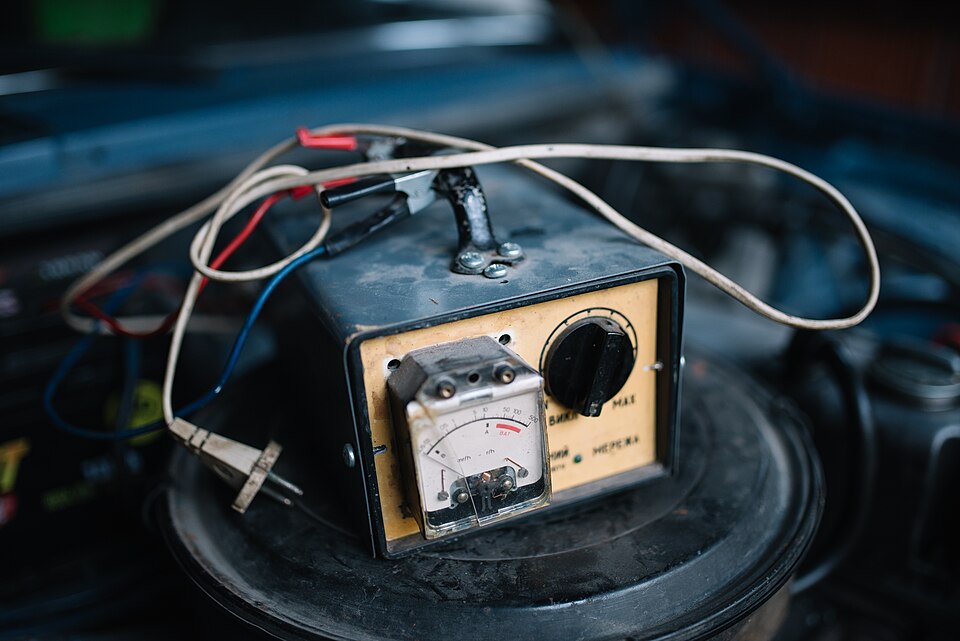
Featured photograph: Nenad Stojković (Shixart1985), Wikimedia Commons, CC BY 2.0. Shown as a representative garage charging scene, not an endorsement of any reviewed model.