Automatic Chicken Coop Doors: Solar, Battery, Safety and Fit Compared
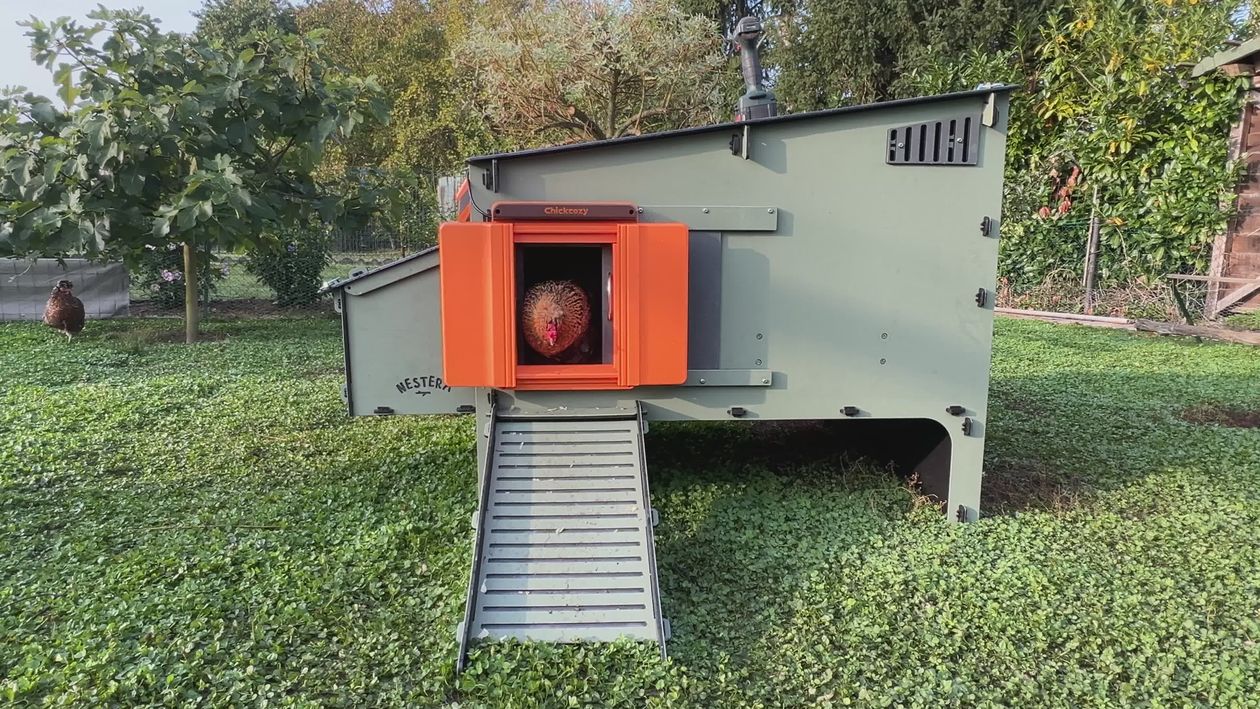
At dusk, a motorized pop door has one job that matters far more than opening on schedule: the right birds need to be inside before it closes, and the entrance must remain secure afterward. A sophisticated controller cannot fix a narrow opening, frozen tracks, loose hardware cloth, or a flock that prefers to sleep outdoors. That is why comparing the best automatic chicken coop doors for backyard chickens begins with the coop itself rather than advertised battery life or an app screenshot.
This guide compares ten genuinely different ways to automate a chicken entrance, including battery-operated complete doors, solar-charged sliding units, a retrofit motor, a horizontally opening system and a heavy-duty screw actuator. We explain the tradeoffs in opening size, dusk programming, obstruction handling, predator resistance, installation and replacement parts. Our analysis uses published specifications and retailer information, not hands-on field testing. Before ordering, confirm the selected version, available power and full installation dimensions; some similarly named products are motor-only openers rather than complete door kits.
As an Amazon Associate, Size Them Up earns from qualifying purchases.
Quick Picks for Different Coop Setups
Automatic Chicken Coop Door Comparison
Opening measurements are usable passage dimensions only where independently published. For other products, confirm clear width and height before cutting. “Power” and “control” describe the selected model, not other variations within the same brand.
| Door and photo | Power | Control method | Opening / fit | Amazon |
|---|---|---|---|---|
1. RUN-CHICKEN T50 Automatic Coop Door (Gray) |
2 AA batteries | Timer + sunrise/sunset; local app setup | About 8 × 10 in | Check on Amazon |
2. RUN-CHICKEN Eternal Solar Door (Gray) |
Solar + rechargeable backup | Timer, daylight, app setup | Verify chosen variation | Check on Amazon |
3. Chickcozy Solar Dual-Motor Door (SR4.0.3) |
Solar + USB backup | Multiple automatic operating modes | Verify clear doorway separately | Check on Amazon |
4. NyPots CD04 Solar Automatic Chicken Door |
Solar + USB-C charging | Timer, light sensor, remote and manual | About 8.2 × 9.6 in | Check on Amazon |
5. ChickenGuard Pro Battery-Powered Opener |
4 AA batteries; optional compatible DC | Timer, daylight and manual control | Depends on separately fitted door | Check on Amazon |
6. FarmLite Automatic Door — Non-Battery Version |
External power; confirm exact kit | Timer or light-sensor option | Around 8.5 × 10.5 in in some listings | Check on Amazon |
7. CHAMUTY 7W Solar Horizontal Dual-Door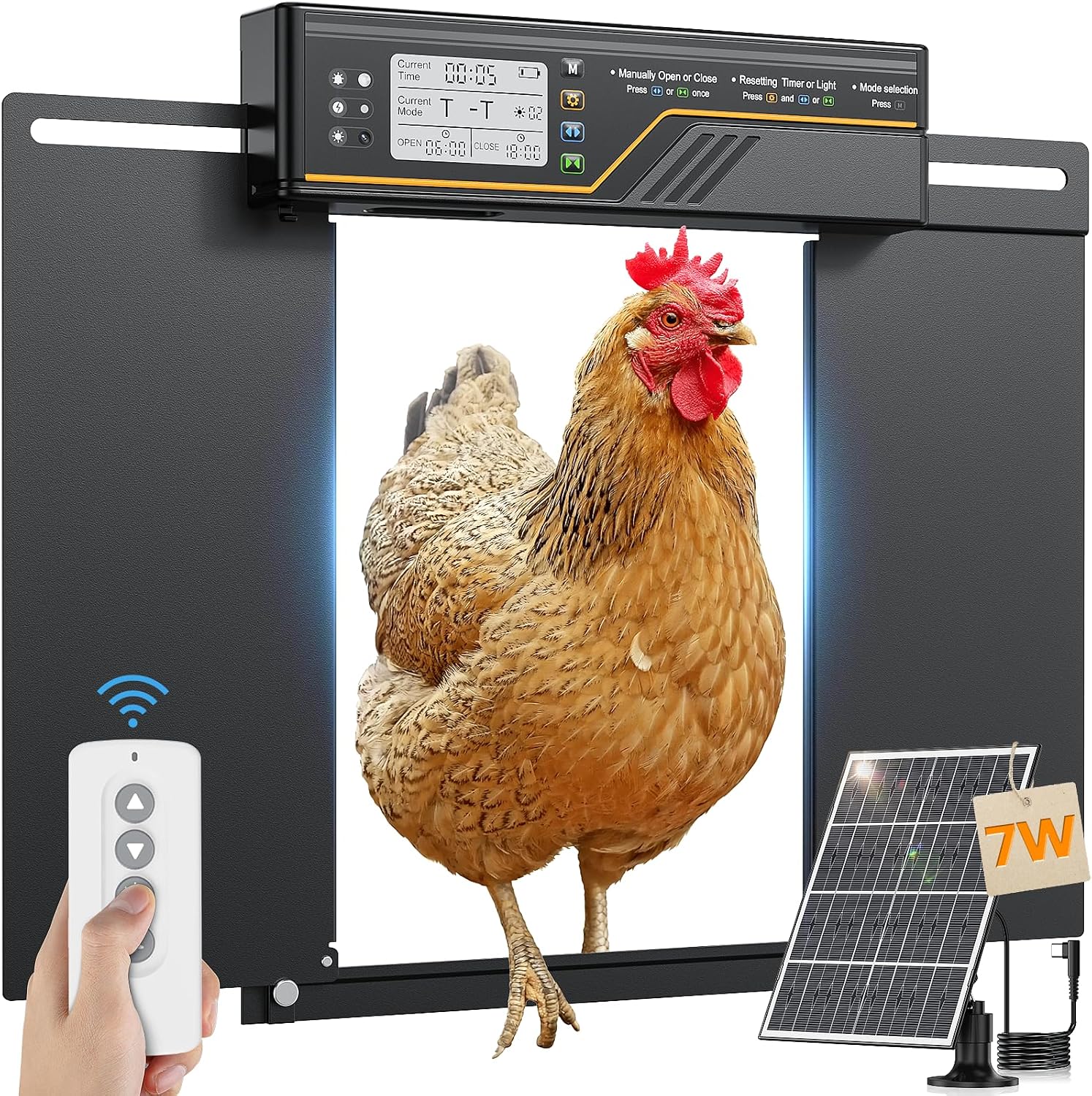 |
7W solar + rechargeable power | Timer, light sensor and remote | Advertised 11.6 × 8.6 in | Check on Amazon |
8. JVR Automatic Chicken Coop Door with Timer |
Powered actuator; verify supply package | Programmable LCD timer | Around 11 × 12 in in published listings | Check on Amazon |
9. VEVOR Battery Automatic Chicken Coop Door (Orange) |
Replaceable batteries | Timer and manual settings | Verify usable opening | Check on Amazon |
10. AsFrost 7W Solar Chicken Door (Orange) |
7W solar + USB backup | Light sensor and timer | Measure selected variation | Check on Amazon |
How We Selected These Coop Doors
We compared different mechanisms rather than ten colors of the same model: lifting or horizontal slide, battery or solar power, opener-only versus complete kit, control modes, published passage size, lock type, obstruction behavior and parts availability. Official manuals and product-specific listings inform the comparisons. We did not conduct physical predator, cold-weather or pinch-resistance testing, and do not imply that a manufacturer’s claim is a measured guarantee. Check the exact offer variant and current retailer details before purchasing.
Detailed Automatic Chicken Coop Door Reviews
1. RUN-CHICKEN T50 Automatic Coop Door (Gray)
Best for: Everyday coops needing a simple complete metal door.
The RUN-CHICKEN T50 is a compact complete sliding-door assembly rather than a motor that pulls an existing hatch with a cord. That distinction matters when a keeper wants to replace a worn pop-hole door in one project. Published specifications describe an opening around 8 by 10 inches, a two-AA battery arrangement, timer programming and a companion app for setup; this is not the same as continuous Wi-Fi monitoring from another location. Its motor-driven locking design is promoted as a way to resist lifting from below, but no retail door makes weak wire, loose hardware or a damaged coop predator-proof. Compared with the brand’s Eternal solar model, the T50 avoids panel exposure and rechargeable-battery care while creating a recurring AA replacement task. Before buying, measure your largest bird with room for an easy step-through, then confirm the actual outside frame dimensions and screw positions. If you need a giant-breed doorway, do not assume the T50’s standard opening is adequate.
2. RUN-CHICKEN Eternal Solar Door (Gray)
Best for: Sunny runs where changing disposable batteries is inconvenient.
The Eternal is a separate product family from the T50, built around solar charging and a rechargeable backup rather than relying primarily on fresh AA cells. That makes it a candidate for buyers searching for the best solar automatic chicken coop door with battery backup. A solar label is not a promise of unlimited winter operation: the panel needs appropriate daylight exposure and the rechargeable cell has its own maintenance and aging considerations. If the coop is under trees or behind a north-facing wall, check the manufacturer’s mounting instructions and backup charging options before relying on the panel. The Eternal also advertises timer and daylight settings, so you can base closure on flock behavior instead of always accepting the changing sunset time. Both this model and the T50 use a complete sliding-door format, yet their power systems and routine upkeep are genuinely different. Confirm the exact gray Eternal configuration, not an accessory, replacement panel or similarly named battery-only door.
3. Chickcozy Solar Dual-Motor Door (SR4.0.3)
Best for: Keepers prioritizing how a closing door senses an obstruction.
The Chickcozy SR4.0.3 is worth examining because its advertised dual-motor locking and multi-stage anti-pinch design make the door mechanism itself the main buying decision. The researched model carries a solar charging arrangement with USB backup, rather than depending on an extension cord to the shed. Obstruction protection is important, but a seller’s use of “anti-pinch” does not mean every bird, posture or object will be detected perfectly. Ask how the door reacts after repeated interference: whether it reopens, retries, waits, or remains open with an alert is more useful than a one-word safety claim. This model’s outside housing is larger than the clear hole, so measure the wood needed for mounting screws, nearby trim and the ramp. It can appeal to someone seeking an automatic chicken coop door with anti-pinch safety for a flock that lingers at dusk. The tradeoff is having more moving parts and a charging system to maintain.
4. NyPots CD04 Solar Automatic Chicken Door
Best for: Budget-oriented standard hens needing timer and light options.
NyPots CD04 offers a small, integrated solar-powered door with an LCD display, handheld remote and several ways to set opening and closing. Third-party product-specific specifications identify an opening approximately 8.2 by 9.6 inches and an aluminum-alloy/ABS housing, making it easier to do a real size check than with listings that never publish the usable hole. This is a practical candidate when comparing an automatic chicken coop door with timer and light sensor: the timer gives a predictable schedule while light-based operation follows seasonal changes. Neither setting should be assumed correct until you observe your birds for several evenings. Budget designs can involve more uncertainty about spare parts and the exact anti-pinch response. Unlike an established opener-only system, the CD04 comes as a complete door intended to mount over an opening. Make a full-size template before cutting the wall, and verify that the solar panel cable can reach the planned sun-facing position.
5. ChickenGuard Pro Battery-Powered Opener
Best for: Retrofitting a sound existing vertically lifting pop door.
ChickenGuard Pro is the important exception in this comparison: this particular researched offer is an opener and control mechanism, not necessarily a complete replacement sliding door with rails. That is useful for owners who already have a smooth-lifting, suitably weighted pop-hole panel and want to automate it without buying duplicate hardware. The manufacturer describes four operating choices including a light sensor and timer, and a stated lift capacity around two kilograms; inspect the exact kit contents because self-locking tracks belong to other packages. An ordinary lift motor cannot automatically make an existing wooden flap resistant to raccoon lifting. For a buyer wanting an automatic chicken coop door opener for an existing wooden coop, check the door weight, cord routing, side friction, mounting height and whether the track physically blocks pulling upward. Compared with complete NyPots or VEVOR units, this approach takes more planning but can preserve a well-built coop entrance. Replacement parts and controller support may also matter over multiple seasons.
6. FarmLite Automatic Door — Non-Battery Version
Best for: Coops with dependable nearby electrical power.
FarmLite’s non-battery version targets owners who prefer not to manage AA cells or small solar charging panels. That is an attractive idea for a coop near a barn or garage with suitable power infrastructure. However, some seller descriptions of FarmLite variants are inconsistent about power and included components; the correct buying decision is to verify the exact cord, controller and adapter on the selected product page, not assume any electrical version is ready for an outdoor extension cord. With a roughly standard chicken-sized passage in referenced descriptions, it is more appropriate for ordinary laying hens than as an unmeasured solution for large geese. A schedule or light sensor can reduce manual opening, but the door still needs a manual procedure if power is interrupted. When shopping for an electric automatic chicken coop door without batteries, include the cost of safe weatherproof power distribution and consider whether the power source is protected from water and pecking birds. Do not rely on an unapproved improvised electrical installation.
7. CHAMUTY 7W Solar Horizontal Dual-Door
Best for: A wider doorway where vertical rail clearance is limited.
CHAMUTY’s horizontal dual-panel configuration is a meaningful alternative to the common guillotine-style slide-up door. Rather than reserving headroom above the hole for a single tall panel, it opens laterally from the middle. That geometry can help when a roof joist, low coop wall or fixed nest box prevents upward travel. Product-specific listings describe an opening near 11.6 by 8.6 inches, a 7-watt solar panel and timer, light-sensor and remote operation, but those are published claims rather than measurements we made. The important caution is that a wide opening still needs sufficient height and there must be space for both side panels to retract without striking a frame or fastener. This is worth comparing as a solar automatic chicken coop door for a large coop opening, particularly when the available opening is wider rather than taller. Buyers should check how the two panels lock and stop if a bird is in the center; do not presume lateral motion guarantees safety.
8. JVR Automatic Chicken Coop Door with Timer
Best for: Keepers prioritizing actuator resistance and a controlled schedule.
JVR’s timer version is built around a heavier-duty mechanical approach than many small, inexpensive solar doors. Product descriptions identify an aluminum door and an industrial screw-rod actuator, a design that can resist being pushed open when correctly installed. The commonly cited approximately 11 by 12-inch opening gives more space than standard 8-inch-wide pop holes, but mounting dimensions still need to be checked independently of clear travel area. This is a sensible comparison for owners searching for an automatic chicken coop door with secure locking for raccoons, provided the rest of the coop has strong latches and hardware cloth. The timer-centric design can make sense when you want predictable schedules instead of relying on ambient light, yet it also means changing morning and evening times as daylight shifts. Confirm the actual motor power and included wiring in the selected listing. Actuator components and guides should be kept clean of packed bedding or debris, especially where snow melts beside the coop.
9. VEVOR Battery Automatic Chicken Coop Door (Orange)
Best for: Simple, lower-cost automation without solar-panel placement.
This VEVOR battery-operated model is for buyers who value a straightforward local timer and manual operation more than a phone app or solar accessory. The matching listing describes an aluminum-alloy door, battery operation and an anti-pinch arrangement, but it does not establish that every obstruction will be handled safely. Some VEVOR product families have solar charging and light sensors; do not confuse those with this separate battery and timer configuration. In an automatic chicken coop door for cold climates, replaceable batteries can be convenient if a remote solar panel would be shaded, though cold temperatures can still reduce battery performance and freeze the door guides. Owners should plan a battery-change schedule and keep a manual backup way to secure the doorway. A compact, inexpensive door can be reasonable within a well-protected run, but do not make price the deciding factor before checking clear opening dimensions, weather sealing and how resistant the closed door is to lifting. Confirm the selected orange version’s included mounting hardware.
10. AsFrost 7W Solar Chicken Door (Orange)
Best for: Small coops with a sunny wall and manual charging fallback.
AsFrost offers a complete aluminum automatic chicken door paired with a 7-watt solar panel and alternative USB charging. The obvious selling point is its power flexibility: a sunny coop can use the panel for ordinary recharging while the owner has another way to recover after an extended low-light spell. Published listings also describe light-sensor and timer operation. Do not assume a solar automatic chicken coop door for winter will be trouble-free: wet litter, ice on side tracks, shadows and weak batteries can all interfere with the actual closure even when the controller is powered. Compared with the RUN-CHICKEN Eternal, the AsFrost trades a more established branded support ecosystem for a simpler value-oriented package. Its listed anti-pinch capability is worth reviewing in the manual, particularly what happens after multiple obstructions and whether the opening remains unsecured. Confirm the orange unit, panel dimensions, charging cable and the true pass-through size before cutting the coop wall.
Quick Selection Guide
How to Choose an Automatic Chicken Coop Door
1. Measure the clear hole and the whole moving-door footprint
Measure your largest adult bird standing normally, then allow enough room for tail, wing and body movement. A published 8-inch-wide opening may work for standard hens but be inappropriate for some larger breeds. Check the wall’s cutout, outer faceplate, motor box, rail travel, adjacent nest boxes and the ramp position. A vertical sliding door needs free space above its opening, while a horizontal dual-panel door needs space on both sides. A labeled extra-large door is not automatically suitable for turkeys or geese; compare actual usable measurements.
2. Battery power versus solar charging versus an external supply
A best solar automatic chicken coop door with battery backup purchase should account for the sunniest mounting face, length of panel cable, battery chemistry, recharge method, and how long a depleted battery takes to recover. Solar panels do not create power under snow cover. AA-powered doors avoid charging-system complexity but need scheduled replacement. Externally powered doors require properly routed, weather-appropriate wiring and a plan for an outage. Never run household AC connections where birds can peck the cord or water can collect. Compare the intended routine over an entire year rather than solely on summer performance.
3. Light sensor versus exact clock schedule
An automatic chicken coop door with timer and light sensor is useful because the options solve different problems. A light sensor tracks the local dusk and dawn pattern but can be fooled by shading, a floodlight, a bright porch or a storm. A timer is predictable but must be adjusted for seasonal daylight and the flock’s actual roosting behavior. The best practice is to observe several evenings and set closing late enough that the final hens are reliably inside. An app described only as Bluetooth may program the door while nearby without giving you remote verification from work or vacation.
4. What a real obstruction response should do
For an automatic chicken coop door with anti-pinch safety, the useful questions are whether resistance stops the motor, causes it to reverse, starts a retry and eventually leaves the entry open. These behaviors are not interchangeable. A door that stops indefinitely may protect a bird from a direct pinch but leave the coop exposed all night. During installation, follow the manufacturer’s prescribed safe obstruction test without putting a live bird or your fingers under a moving blade. Review the programmed recovery behavior; never infer it from an anti-pinch badge alone.
5. Motor-only retrofits versus complete kits
An automatic chicken coop door opener for an existing wooden coop can save replacing a well-fitted door. The critical checks are panel weight, lift friction, cord routing and whether the closed panel can be lifted by a predator. ChickenGuard Pro is an opener in the selected configuration; products such as NyPots include a complete frame and panel. A retrofit is not automatically cheaper once rails, a panel, latches and suitable power are added. Check whether spare cords, motors and controllers can be ordered later and whether installation uses wood screws into sound structure rather than thin siding.
6. Locks, raccoons and the rest of the coop
An automatic chicken coop door with secure locking for raccoons should resist lifting or pulling from outside, rather than merely close by gravity. A worm-drive or motor lock can help, but effective night protection also requires secure side doors, hardware cloth, a protected run and a roof or digging barrier appropriate to local predators. “Predator-proof” in a product title is not proof of a completed enclosure’s resistance. In areas with persistent predators, check that the door has actually latched every evening and build a plan to secure it manually after an outage.
7. The cold-weather reality
A solar automatic chicken coop door for winter is only as dependable as its panel exposure, battery temperature behavior and clean tracks. Ice, wet bedding and frost can hold a sliding frame even when the motor runs. Mount it away from roof runoff, check weather seals, and clear packed snow around the ramp. Follow the published temperature range for the precise model, not a competitor’s. With severe weather expected, test the morning and evening travel before relying on the automatic schedule.
One Buying Tip
Do a seven-evening flock-and-door audit before trusting automation. After installation, watch all birds settle, check the door’s full open/close path, and record whether the last bird returns before the scheduled closing time. A door that works perfectly on the workbench can still close too early for the hens using your coop.
Installation and Maintenance: Avoid These Common Failures
Problem: the door opens but will not close all the way
Look first for bedding caught in side tracks, a misaligned frame or a low battery. Follow the maker’s safe reset and calibration procedure; do not force a stalled gear with a screwdriver while power is connected. Check that the wood siding has not warped around the housing and that the lower track is not beneath a roof drip line.
Problem: the sun sets but the flock is still outside
Move the light sensor away from direct artificial light or a strongly shaded wall if the installation instructions allow it. Use the timer to delay closing, and observe the flock for several evenings. Do not use the automatic mechanism as a substitute for checking that every hen returned to the coop.
Problem: a raccoon tests or lifts the closed door
Confirm that the actual model includes a positive lock or mechanically resisted actuator and that the door panel cannot be raised by hand once latched. Check all adjacent siding, mesh and access panels. A better motor will not protect the coop if another side is unsecured.
Problem: winter charging stops or the door freezes
Clear snow from the solar panel, inspect charging indicators, remove ice from the rails and switch to approved backup charging or manual closure if necessary. Do not pour boiling water on electronics or spray lubricants that the manufacturer prohibits. Keep dry batteries or the correct approved charger available, whichever your system uses.
Problem: a replacement part is needed in year three
Before selecting a door, check whether the company sells a separate motor, controller, door panel, cord or solar battery. A higher-priced model with obtainable parts may be a better long-term value than repeatedly replacing an entire inexpensive kit. If the coop uses a remote weather sensor, also inspect cable routing and connector corrosion periodically.
Related supplies to consider
Good door automation is one part of poultry-housing upkeep. Our backyard weather-station guide discusses outdoor temperature and precipitation monitoring, while the roof-rake guide covers winter roof snow removal without claiming it replaces coop weatherproofing. For tools used when building or repairing a wooden run, compare the cordless electric screwdrivers guide; use appropriate structural fasteners for your specific coop.
Frequently Asked Questions
Do automatic chicken coop doors really keep predators out?
They can close an entrance on schedule, and some use motor locks or screw-drive resistance. But no door compensates for weak wire, an uncovered run, inadequate latches or a bird left outdoors. Inspect the whole enclosure and check that the door actually latched after dusk.
Is solar or battery power better for a backyard coop?
Solar can reduce routine disposable battery replacement when the panel gets sunlight. Replaceable batteries may be simpler in deep shade and during extended overcast winters. Compare the charging backup, replacement-cell availability, weather conditions and whether your model has a suitable manual override.
Can I add an automatic opener to the existing wooden coop door?
Yes, for compatible existing lifting panels. Check their weight, travel, guides and lock. A motor-only opener, such as the selected ChickenGuard Pro package, does not necessarily include the door panel, self-locking rails or all required fasteners.
Will a timer or a light sensor stop the door too early?
Either can be wrong for a particular flock. Set a timer based on the birds’ real nightly return and adjust for the season; position light sensors according to the manufacturer’s guidance. Observe the first several evenings and confirm that all birds have entered.
How large must a chicken-coop entrance be for bigger breeds?
There is no universal width for every variety of hen, goose or turkey. Compare the actual clear opening width and height with the largest adult bird’s dimensions, then leave room to walk naturally. Do not use external housing dimensions as the usable opening.
What happens if the automatic door detects a chicken underneath?
The response varies by model: stop, reverse, delay and retry, or remain open after repeated obstructions. Read the exact safety sequence in the product manual and perform only the recommended setup tests, without placing birds or fingers under the closing panel.
Do smart chicken doors require Wi-Fi?
Not always. Some smartphone apps use short-range Bluetooth to configure a schedule, while true Wi-Fi-connected systems may provide remote operation or status notifications. Confirm the app connection method and any recurring requirements before choosing.
Final Verdict
For a typical small flock and a standard opening, the RUN-CHICKEN T50 is a clear conventional-battery choice. If the coop receives reliable sun, the RUN-CHICKEN Eternal or AsFrost solar offers a different charging arrangement. For keepers replacing a complete door on a budget, inspect the NyPots CD04 and VEVOR while paying particular attention to long-term spare parts. ChickenGuard Pro makes more sense when an existing lifting panel is worth keeping. The CHAMUTY horizontal door has a truly different mounting geometry, and the JVR actuator suits buyers who care most about deliberate mechanical resistance.
Choose a model only after verifying the exact doorway dimensions, power wiring or batteries, closing behavior, and replacement parts. No automatic door eliminates the need to ensure every bird is inside and the rest of the coop is secured at night.
Featured image: Frame from automatic chicken-coop footage by Papy Nounn / Pexels, under the Pexels License. Editorial illustration; it does not identify a model reviewed above.