Best handheld Ham Radio for Beginners
 Amateur radio, or “ham radio” for short, can be used to communicate with people near and far, during outdoor vacations or from the comfort of your home. Using ham radio is almost like going on a treasure hunt where the treasure is discovering signals and communicating with other users. The popular hobby of ham radio can also become incredibly useful in an emergency when other communication options are out of service.
If you’re interested in taking up ham radio as a hobby, you’re in luck! It’s not exclusive, and with some dedication, you’ll be making connections in no time. There are plenty of handheld radio models available for people of all skill levels, at many price points. If you are just starting out with ham radio, you may want to begin with a cheaper unit so that you’ll be able to explore the possibilities of amateur radio without breaking the bank. However, these options may not always be super user-friendly, or they may require additional accessories to be useful. If you plan to dedicate a lot of time and energy to ham radio, you might want to consider spending more in order to get a higher-end product with more functions and capabilities. There is no “best” radio—the choice truly depends on your personal priorities as an amateur radio user, but if you are shopping and looking for the best handheld ham radio for a beginner enthusiast then take a look at the carefully selected reviews below.
Regardless of which model you choose, always be careful to acquire the proper licensing for legal use of your handheld radio!
As an Amazon Associate, SizeThemUp earns from qualifying purchases.
This expanded guide separates the basics every beginner needs from advanced features that only make sense in the right local radio community. You can use the selection checklist, licensing primer and troubleshooting advice even if you’re not buying a new handheld.
Quick Picks: Find the Right Starting Point
Yaesu FT-65R — a dependable first analog handheld for club repeaters; TIDRADIO TD-H3 (Ham Version, Crystal) — beginners prioritizing usb-c and convenient channel programming; BaoFeng UV-82HP (Red) — budget analog radio with dual push-to-talk controls; Yaesu FT-70DR — first digital handheld where system fusion is active; AnyTone AT-D878UVII Plus — operators moving from analog fm into local dmr networks.
How We Compared These Radios
We compared identifiable products against manufacturer documentation and current product-detail information, with attention to bands, analog and digital modes, programming approaches, battery options, accessories and clear beginner tradeoffs. Reviews describe published features and practical implications; SizeThemUp has not performed hands-on lab tests of all these radios. Specific package versions can change, so check the exact linked offer and follow the manufacturer’s manual. The comparison is organized to make the range of choices visible, not to claim that every model is equally suited to every beginner.
Quick Comparison: Handheld Ham Radios for Beginners
Compare each radio by its main strength and operating mode, then select a model name to jump to the detailed review.
| Radio | Best for | Mode | Amazon |
|---|---|---|---|
 1. BaoFeng UV-82HP (Red) |
Budget analog radio with dual push-to-talk controls | Analog FM · VHF/UHF | Check the latest price on Amazon |
 2. BaoFeng UV-5R Two-Radio Pack |
Two inexpensive analog handhelds for learning together | Analog FM · VHF/UHF | Check the latest price on Amazon |
 3. BTECH BF-F8HP PRO |
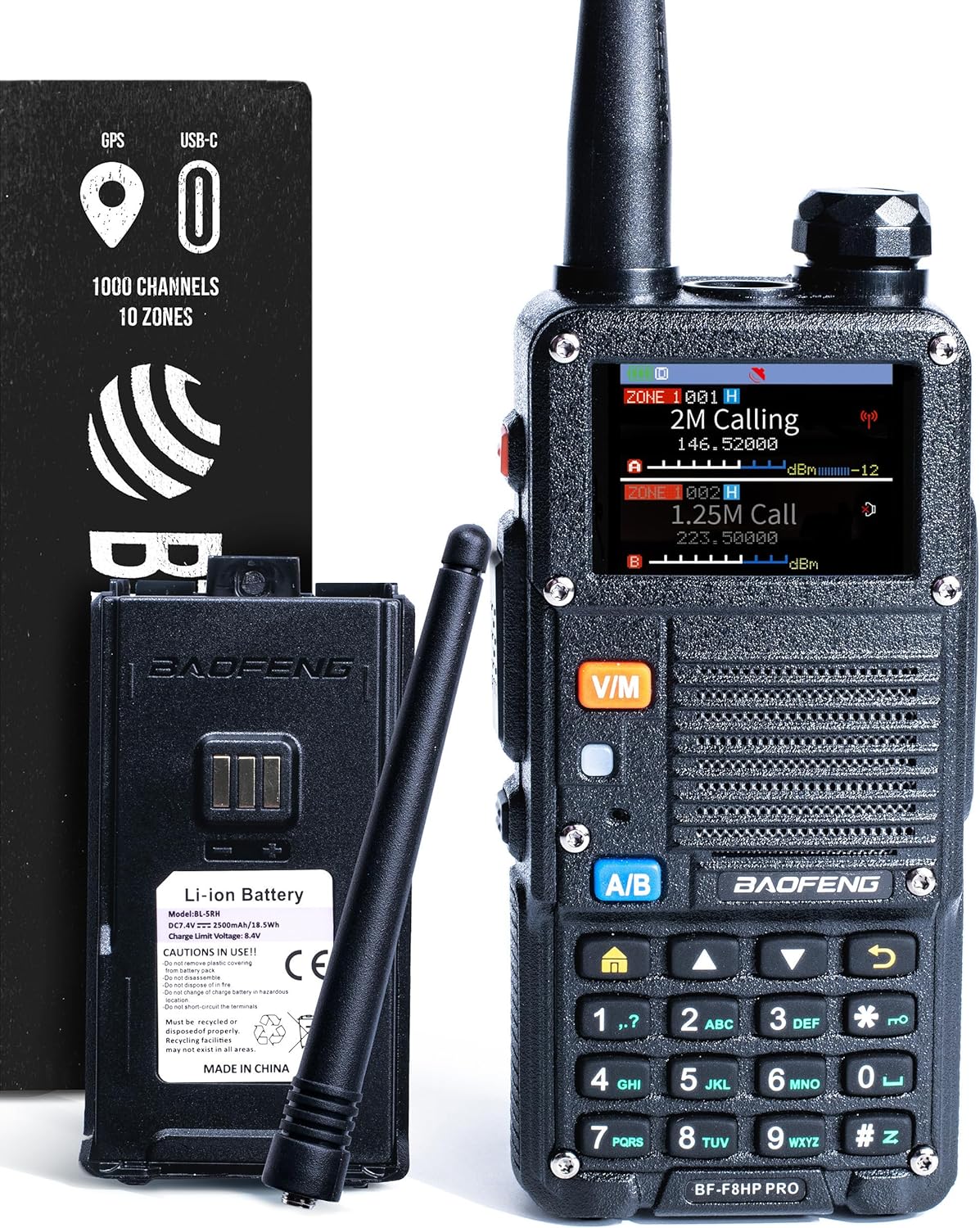
Organized analog channels, extra band options and GPS | Analog FM · VHF / 1.25 m / UHF | Check the latest price on Amazon |
 4. AnyTone AT-D878UVII Plus |
Operators moving from analog FM into local DMR networks | Analog FM + DMR · VHF/UHF | Check the latest price on Amazon |
 5. Radioddity GA-510 |
Budget analog operation with spare-power accessories | Analog FM · VHF/UHF | Check the latest price on Amazon |
 6. TIDRADIO TD-H3 (Ham Version, Crystal) |
Beginners prioritizing USB-C and convenient channel programming | Analog FM · VHF/UHF | Check the latest price on Amazon |
 7. Yaesu FT-65R |
A dependable first analog handheld for club repeaters | Analog FM · VHF/UHF | Check the latest price on Amazon |
 8. Yaesu FT-70DR |
First digital handheld where System Fusion is active | Analog FM + C4FM · VHF/UHF | Check the latest price on Amazon |
 9. Quansheng UV-K6 / UV-K5(8) |
Curious beginners interested in listening and learning menus | Analog FM · VHF/UHF | Check the latest price on Amazon |
 10. BaoFeng DM32 / DM-32UV |
Affordable entry into DMR for technically inclined operators | Analog FM + DMR · VHF/UHF | Check the latest price on Amazon |
Our Handheld Ham Radio Reviews
1. BaoFeng UV-82HP (Red) — Budget analog radio with dual push-to-talk controls
The UV-82HP is an interesting first handheld if you like the idea of keeping two nearby frequencies available without repeatedly changing the display selection. Its dual push-to-talk arrangement is the defining difference from many conventional keypad radios: with appropriate programming, the operator can choose which monitored side to transmit on. That flexibility can be handy when learning a local club repeater and a simplex channel, though you must still verify the selected frequency before pressing transmit. The radio uses a traditional analog FM workflow, so beginners should plan on learning CTCSS tones, repeater offsets and memory-channel setup rather than expecting a plug-and-play walkie-talkie. The linked item is specifically the red UV-82HP configuration; compare its included battery, charger and programming requirements with any alternate bundles. Output power does not guarantee long-distance communication. Terrain, the antenna and access to a nearby repeater often have much more influence on the result.
Best for: Budget analog radio with dual push-to-talk controls.
Buying tip: Check the exact UV-82HP version and the supplied battery/charger; the red listing is not interchangeable with every UV-82 accessory.
2. BaoFeng UV-5R Two-Radio Pack — Two inexpensive analog handhelds for learning together
The classic UV-5R remains familiar to many amateur-radio clubs because the basic keypad layout and programming workflows have been discussed for years. This particular Amazon offer is a two-radio pack, making it different from a single UV-5R listing. It could appeal to a household with two newly licensed operators or to a club mentor who wants two matching radios for guided learning. A pair of units is not automatically an appropriate substitute for family walkie-talkies: transmitting on amateur frequencies still requires the applicable operator privileges, and a ham handheld is not automatically approved for GMRS or FRS channels. Learn to identify the selected VFO or memory, set a repeater’s offset and tone and use the correct channel before transmitting. The standard antenna may be adequate around strong nearby repeaters but should not be judged by exaggerated range promises. If you only need one personal radio, compare the total bundle cost and accessory quality with a simpler single-handheld choice.
Best for: Two inexpensive analog handhelds for learning together.
Buying tip: Buy this package only if you need two units; confirm antennas, chargers and batteries for both radios before comparing its price to a single-radio listing.
3. BTECH BF-F8HP PRO — Organized analog channels, extra band options and GPS
The BF-F8HP PRO serves a different kind of beginner: someone who expects to participate in several local clubs, carry programmed channels while traveling, or experiment with amateur activity beyond the most common two bands. Its advertised tri-band amateur operation includes 1.25 meters as well as standard 2-meter and 70-centimeter coverage, while named channel zones help separate home, travel and event frequencies. GPS and additional receive functions can be useful, but they also add menu choices. A first-time operator should verify which frequencies the FCC permits under the relevant license and keep any receive-only bands separate from transmit memories. The presence of aviation reception does not confer permission to transmit on aviation frequencies. Compared with a very basic analog radio, the PRO is more capable but also demands a thoughtful channel plan. Treat its higher-power marketing cautiously and prioritize good programming, a comfortable control layout and compatible charging accessories.
Best for: Organized analog channels, extra band options and GPS.
Buying tip: Check whether the 1.25-meter band is active near you; don’t pay for extra bands solely because they look impressive on the specification sheet.
4. AnyTone AT-D878UVII Plus — Operators moving from analog FM into local DMR networks
The AT-D878UVII Plus is a strong step-up option when you have a practical reason to use DMR. It combines traditional amateur analog FM with the Digital Mobile Radio workflow, but the two sides are not configured in exactly the same way. For DMR operation, a novice must understand channels, color codes, talkgroups, contacts and zones before a radio becomes enjoyable to use. The advertised large contact capacity is useful for active digital operators but provides little value if your nearest repeaters are analog-only. The BridgeCom-supported offer includes training-oriented materials, so verify exactly which accessories and learning resources are included in the current package. Its GPS, Bluetooth and APRS-related functions are additional considerations rather than reasons to skip fundamental radio operating skills. A newly licensed Technician can use this as a first radio, but will typically learn faster with help from a local DMR group. Check digital-mode compatibility first; DMR does not automatically talk to Yaesu System Fusion or Icom D-STAR.
Best for: Operators moving from analog FM into local DMR networks.
Buying tip: Before buying, ask your local amateur club whether nearby DMR repeaters and talkgroups are active, and whether they can share a compatible programming example.
5. Radioddity GA-510 — Budget analog operation with spare-power accessories
The GA-510 is aimed at users who want a relatively affordable analog handheld with practical accessories rather than a fully digital ecosystem. The product listing emphasizes selectable transmit-power levels, a programming cable and two rechargeable batteries, which may be more useful on a weekend event than an unneeded digital feature. The cable can be especially helpful because entering every frequency, repeater offset, tone and channel name through a small keypad becomes tedious as a channel list grows. Beginners should verify software compatibility before connecting the radio to a computer and always read the existing configuration before writing a new one. When operating outdoors, keeping a charged spare battery is a sensible backup, but it is not proof that the radio is weatherproof. The GA-510’s advertised higher-power setting should not be confused with reliable long-range performance. A poorly placed antenna can still limit coverage even if more transmitter power is available.
Best for: Budget analog operation with spare-power accessories.
Buying tip: Confirm that both batteries and the programming cable are included in your particular listing; a bundle is only valuable if you will use the extras.
6. TIDRADIO TD-H3 (Ham Version, Crystal) — Beginners prioritizing USB-C and convenient channel programming
The TD-H3 is a useful example of how inexpensive radios have become easier to set up. Its amateur-radio configuration combines a compact form with USB-C charging and programming functions, reducing the need for a dedicated charging dock or a proprietary data cable. Certain programming features can work through compatible apps or software, which is attractive when you regularly update local repeaters or travel to club events. The important trap is version confusion: TIDRADIO also sells GMRS-oriented TD-H3 packages, and the frequencies and operating authorizations are not interchangeable merely because the cases look similar. The linked offer is explicitly described as the ham-radio Crystal configuration. Pay attention to package contents and the app or firmware version before assuming a feature is available. For a new licensee, the best starting task is to program a single known repeater accurately and test it under calm conditions. Modern conveniences help, but they do not replace understanding what the radio is transmitting.
Best for: Beginners prioritizing USB-C and convenient channel programming.
Buying tip: Choose the exact ham-radio version and verify the supported programming app and firmware; similar-looking GMRS versions are not interchangeable.
7. Yaesu FT-65R — A dependable first analog handheld for club repeaters
For a beginner who wants to learn how amateur radio works rather than experiment with many advanced menus, the FT-65R is one of the clearest choices. It focuses on analog 2-meter and 70-centimeter operation, using familiar keypad controls and memory channels that fit the way most local FM repeaters are accessed. The manufacturer describes a rugged body, a strong front speaker and several selectable output-power settings. Those features matter for portable use, but the real advantage for beginners is predictability: a club member can help you enter a repeater’s receive frequency, transmit offset and tone, then save the configuration for the next meeting. The main downside is convenience. Unlike some newer budget handhelds, it does not build charging and app-based programming around USB-C. Check the exact package for its battery, charger and programming support. If your local club is primarily analog, buying expensive digital capabilities before you need them is unlikely to improve your first on-air experience.
Best for: A dependable first analog handheld for club repeaters.
Buying tip: Ask your club which repeaters they use, then check whether you need a separate programming cable or spare battery to build your initial kit.
8. Yaesu FT-70DR — First digital handheld where System Fusion is active
The FT-70DR is a sensible introduction to digital voice only when your local amateur community has a real reason to use it. It supports ordinary analog FM as well as Yaesu’s C4FM System Fusion system, so it can still participate in conventional repeaters while you learn the differences between modes. That flexibility sounds universal on paper, but digital networks are not interchangeable: an operator on a DMR or D-STAR repeater generally cannot talk to a Fusion-only handset without an appropriately configured bridge. For a club with Fusion activity, the FT-70DR gives a beginner a direct path to those contacts while retaining familiar FM capabilities. For someone surrounded by analog repeaters, it introduces cost and setup complexity that may have no immediate benefit. Think about charging, spare battery needs, the clarity of the menu and how often you will actually use digital features. Before purchasing, ask a nearby club member which mode they use during scheduled nets.
Best for: First digital handheld where System Fusion is active.
Buying tip: Confirm that a local Yaesu System Fusion repeater is active before paying for digital capability; C4FM and DMR are not directly compatible.
9. Quansheng UV-K6 / UV-K5(8) — Curious beginners interested in listening and learning menus
The Quansheng UV-K6 is an appealing inexpensive learning tool for people who enjoy understanding radios as devices, not only making conversations. Its basic VHF/UHF analog functions can serve beginner amateur operation, while receive-related features provide room to explore how scanning, channel memories and band selection work. The hobbyist community often discusses alternate firmware and expanded functionality, but that is also the main caution for a new owner: information written for a different revision may not apply to the linked radio, and software changes may create unpredictable or noncompliant transmit behavior. Learn to use the manufacturer’s normal settings before experimenting, and never assume that a frequency visible on the screen is legal to transmit on. The compact controls and low price are strengths; the documentation and variant ecosystem can be frustrating. This is best for a tinkerer willing to verify the exact model, not necessarily for the beginner who wants the simplest possible radio for weekly repeater nets.
Best for: Curious beginners interested in listening and learning menus.
Buying tip: Confirm you are buying the UV-K6 / UV-K5(8) version listed; do not apply online custom-firmware instructions meant for another hardware revision.
10. BaoFeng DM32 / DM-32UV — Affordable entry into DMR for technically inclined operators
The DM32 (also described as DM-32UV) illustrates how digital ham-radio choices are expanding beyond premium brands. It combines analog FM with DMR functionality in an affordable handheld, making it interesting for a technically inclined beginner whose local repeaters or friends already use DMR. The low initial cost does not remove the learning curve. Digital operating requires correctly configured channels, talkgroups, contact entries and other network details; if those are wrong, the radio may seem silent even though it is working. Confirm a local DMR repeater or hotspot plan before purchasing, then use instructions that match the specific firmware and package variant. It also makes sense to keep a simple analog channel programmed for general club activity. Do not assume any branded emergency or wideband receiving feature authorizes transmissions outside amateur allocations. If you have no active DMR community nearby, a well-supported analog handheld is usually an easier place to begin than this more specialized model.
Best for: Affordable entry into DMR for technically inclined operators.
Buying tip: Before considering this DMR radio, confirm local repeater/talkgroup support and find a reliable codeplug tutorial for its exact firmware.
How to Choose a Handheld Ham Radio for Beginners
Buying a first handheld amateur radio makes more sense once you identify who you want to talk with. A ham handheld is useful for nearby analog voice contacts, local repeater nets, community activities, and learning the practical side of radio. It is not automatically a long-distance emergency communicator or a replacement for a mobile phone. Consider the following five decisions before the product price.
Choose your local radio community before choosing a digital mode
In the United States, a Technician license generally gives access to popular 2-meter and 70-centimeter amateur bands. A basic dual-band analog FM handheld is enough for many local clubs and repeaters. If nearby repeaters support a particular digital format, determine whether they use DMR, Yaesu System Fusion/C4FM or D-STAR before investing. Digital formats are different systems, and owning one format does not inherently make it compatible with another. A local club or RepeaterBook listing is a useful starting point; confirm activity and current settings with the repeater’s operator.
Understand the two common bands
2 meters (144–148 MHz) is a popular VHF amateur band for local voice and repeater activity in the U.S. 70 centimeters (420–450 MHz) is a UHF amateur allocation with different propagation characteristics, and repeaters on either band can be useful depending on location. Some radios also offer 1.25-meter amateur operation, weather reception, FM broadcast listening, or aviation receive-only functions. These additional features do not expand your transmission privileges. Frequencies and modes must match your license and applicable regulations.
Check programming rather than chasing the highest wattage
Most repeaters require the correct receive frequency, transmit offset or split, and often a CTCSS or DCS tone. A radio with an understandable menu or reliable programming software can be more helpful than one with a bigger watt number. Check whether the exact handset uses a USB-C data connection, a separate programming cable or a compatible phone app. Do not assume a USB-C charging jack also supports programming. For beginners comparing a handheld ham radio with USB-C charging versus a traditional desktop charging cradle, the best choice is the one you can recharge and configure without guessing.
Consider batteries, antennas and carrying comfort
A spare charged battery can matter on a full day outdoors, but the package and battery shape differ among models. Consider total weight, speaker volume, weather rating, spare-battery availability, connector type and whether you will use a speaker microphone. More transmitter watts cannot reliably overcome mountains, reinforced concrete or poor antenna placement. A good location and a nearby repeater may be more valuable than extra transmit power.
Budget for the actual first-use setup
Before choosing a budget handheld ham radio for beginners, add up the accessories you genuinely need: battery, charging solution, a correct programming cable if applicable, and perhaps a spare battery for field outings. Avoid buying a random antenna or programming kit until you know the connector and software supported by that exact radio. The strongest purchase is one that helps you get on the air confidently rather than one that fills a specification sheet.
Analog FM vs. DMR vs. System Fusion: Quick Decision Guide
Buying tip: Ask a nearby ham club for the names and operating modes of two or three active repeaters before ordering a digital handheld. Those answers can save more frustration than an extra feature list.
How to Set Up Your First Handheld Ham Radio
- Get licensed before transmitting. In the United States, learn the rules and obtain the appropriate FCC amateur-radio license; listening alone does not require an amateur license. The ARRL licensing guide is a starting point.
- Charge and inspect the radio. Follow the manufacturer’s battery and charger instructions, attach the supplied antenna correctly and read the controls before transmitting.
- Choose a real local repeater. Record its band, output frequency, direction and amount of offset, access tone if used, and operating mode. Check with the repeater operator for any access rules.
- Enter the repeater settings carefully. Program one channel manually or with model-compatible software. Do not upload another model’s programming file without checking every transmit setting.
- Listen before speaking. Verify that the channel is correct and that you are authorized to transmit. Follow ordinary call-sign identification and courteous operating practices.
- Test and save a working configuration. Arrange a first contact with a club member. Back up your channel settings and keep a short written reference for local nets and battery care.
This is a general beginner overview, not a substitute for the operating manual or current FCC rules. Club-specific repeater settings and radio menu sequences vary by model.
Common Beginner Problems and How to Fix Them
Recheck the correct transmit offset or split and the required CTCSS/DCS setting. Being able to listen to the repeater does not prove your transmit settings are correct. Confirm the license privilege and talk to the repeater operator.
Check the selected channel, volume, squelch and operating mode. Confirm the antenna is attached and try a known active local frequency. Indoors, move away from electrical noise or toward a window before buying more power.
Handheld VHF/UHF coverage depends heavily on terrain, obstacles, antenna position and whether a repeater is available. A higher location or a suitable repeater often helps more than a headline wattage claim.
Verify the exact radio model and firmware, supported software version, USB driver and whether the connector is data-capable. If the device uses a programming cable, charging-only USB cables will not replace it.
Confirm the repeater’s digital system. DMR and Yaesu Fusion are different; DMR also needs the correct channel, color code, talkgroup and other codeplug fields. Ask a local operator for an appropriate example.
Backlight use, scanning, transmit duty cycle, output setting and battery condition influence runtime. Follow the manufacturer’s battery handling and charging guidance and consider an approved spare pack when your use requires it.
Frequently Asked Questions
Do I need a license to use a handheld ham radio?
In the U.S., amateur transmitting generally requires the proper FCC amateur license; the Technician class is the common entry point. Receiving or listening to transmissions does not itself require an amateur transmitting license. Amateur radios are not automatically authorized for FRS or GMRS transmitting.
How far can a handheld ham radio reach?
There is no trustworthy single distance. Terrain, antenna height, buildings and repeater coverage can change the result dramatically. Simplex contacts are often relatively local; a suitable repeater can extend practical coverage.
What is the best handheld ham radio for beginners using local repeaters?
A conventional dual-band analog FM model is a strong starting point if local repeaters use analog voice. The Yaesu FT-65R offers a familiar, straightforward path, while the TD-H3 adds modern programming conveniences.
What is the difference between simplex and repeater operation?
Simplex is direct radio-to-radio communication on a common frequency. Repeater operation receives your signal on an input frequency and retransmits it on an output frequency, often from a favorable location. It usually requires the correct offset and access tone.
Can an amateur handheld use GMRS or FRS channels?
Do not assume so. The services have separate rules and equipment authorization requirements; a wide frequency range in the menu is not permission to transmit. Use appropriately authorized equipment for the service.
Do I need a computer to program a ham radio?
No. Many radios allow keypad programming, though a cable, app or software may simplify larger channel lists. Verify the exact model’s software and cable support before buying.
Should beginners choose analog or DMR?
Choose what active local operators use. Analog FM usually has a simpler learning curve; DMR requires talkgroups and more configuration. C4FM is another digital system and is not natively interchangeable with DMR.
Can a ham radio replace a phone in an emergency?
It can provide an additional communication method, but coverage and listening operators are not guaranteed. It does not automatically reach 911, and it should not replace an established emergency plan.
Helpful Sources and Related Guides
For regulatory and operating fundamentals, see FCC Amateur Radio Service, ARRL’s first-radio guide, and the FCC amateur frequency rules in 47 CFR § 97.301. For boating applications, compare radio services in our marine radio buying guide; marine VHF radios and amateur handhelds follow different operating requirements. You may also find our portable jump starter guide helpful when building a separate vehicle emergency kit.
Final Verdict
Start with the kind of radio your local club actually uses. For uncomplicated analog repeater learning, the Yaesu FT-65R is a sensible first choice. For a compact, modern charging and programming workflow, compare the TIDRADIO TD-H3 ham version. If you want analog channels and extra organizing features, look at the BF-F8HP PRO. If a local club uses digital voice, choose the matching system: FT-70DR for System Fusion or AnyTone for DMR.
- Conventional first radio: Yaesu FT-65R — Check the latest price on Amazon
- Convenient modern starter: TIDRADIO TD-H3 (Ham) — Check the latest price on Amazon
- Advanced analog options: BF-F8HP PRO — Check the latest price on Amazon
- DMR progression: AnyTone AT-D878UVII Plus — Check the latest price on Amazon
Begin with a correct license, a few relevant repeater memories and a reliable battery; the right radio is the one you can configure confidently and use regularly.